Toronto, Vancouver See Home-Sales Rush Ahead of New Stress-Test Rules

JANET MCFARLAND AND BRENT JANG

TORONTO AND VANCOUVER

20 HOURS AGONOVEMBER 2, 2017

Home sales climbed in October in both Toronto and Vancouver as buyers moved to lock in purchases in Canada’s most expensive cities before new mortgage stress-testing rules take effect in January.

The Toronto Real Estate Board said home sales in the Greater Toronto Area climbed 12 per cent in October, marking the biggest month-over-month growth in sales since Toronto’s overheated housing market hit a sales peak in March. October sales were 27 per cent lower than October last year, however, when the GTA had record sales.

TREB said the average GTA home sold for $780,104 in October, up 0.6 per cent from September and 2.3 per cent higher than the same month last year.

Toronto’s housing market began a modest recovery in September and continued to grow slowly in October, suggesting the GTA has at least halted the sharp downturn in house prices that began in May after the provincial government announced its Fair Housing Plan changes, including a new foreign-buyer tax.

Greater Vancouver, by contrast, has fully shrugged off last year’s market downturn, with the volume of sales climbing 35 per cent in October compared with the same month last year and jumping 7 per cent compared with September. The Real Estate Board of Greater Vancouver said sales in the region were 15 per cent higher than the 10-year average for October.

The benchmark sales price for all homes in Greater Vancouver was $1,042,300 in October, up 12 per cent compared with October last year and an increase of 0.5 per cent over September.

Jason Mercer, TREB’s director of market analysis, said the Toronto market is continuing to follow the recovery pattern of the Vancouver region, which saw sales fall after the B.C. government introduced a foreign-buyer tax in August, 2016, then begin to recover by January this year.

Toronto realtor Eryn Richardson, general manager of Century 21 Heritage Group, said his offices saw home sales climb in October not only compared with September, but also compared with October last year. He says buyers no longer seem concerned about a bubble bursting , so are back shopping for homes.

Mr. Richardson also said buyers are concerned about looming new mortgage stress-testing rules announced by Canada’s banking regulator – the Office of the Superintendent of Financial Institutions – on Oct. 17. Buyers are keen to move before the rules take effect Jan. 1, he said.

“That’s getting people out and buying – I think that’s a big factor for sure,” Mr. Richardson said.

Chris Alexander, regional director for Ontario and the Atlantic region at Re/Max, said he credits the pending mortgage rule change with spurring at least half of the buying action in the GTA in October.

“The OSFI stuff is definitely driving some of this,” he said. “On a year-over-year basis, price appreciation is in healthy territory. I think there’s still a ton of demand and the market fundamentals of the GTA are very strong. … I think we’re in a really good spot.”

The OSFI rule change will require buyers who are making down payments of more than 20 per cent of a home’s value to prove they could still afford their mortgage payments if interest rates were 2 percentage points higher than the rate they negotiated.

Royal LePage chief executive officer Phil Soper said he thinks most buyers will be unaware of the details of the stress-testing rule and are not buying because of them.

Instead, he believes the Toronto market is being driven by high demand for housing due to the region’s strong economy and continuing population growth. He said he now worries about the risk of another huge price runup.

“I’m more concerned about the upside than the downside,” Mr. Soper said. “I hope that the OSFI moves will take some of the steam out of the market in the spring of 2018 and keep a lid on home price appreciation, because I do believe there’s more risk that the market will get away and trend toward that irrational exuberance we saw last year. That would be my bigger fear, rather than the downside.”

Royal LePage real estate agent Shawn Zigelstein, who is based in Richmond Hill, said the biggest factor driving sales has been the large increase in active home listings in the market, which could also lead to sales growth in November compared with October.

TREB reported 18,859 homes were listed for sale in the GTA as of Oct. 31, up 78.5 per cent from 10,563 homes a year ago.

“We have so much more product on the market, it’s up almost 80 per cent year over year,” Mr. Zigelstein said. “It’s a huge number, and we will see how that translates into November and December.”

The condominium sector remains the strongest segment of the housing market in both Toronto and Vancouver, while detached home sales have lagged.

In the GTA, condos sold for an average of $523,041 in October, up 0.5 per cent over September and 21.8 per cent higher than October last year. The average detached home sold for $1,008,207 in the GTA in October, a drop of 0.7 per cent compared with September and a decline of 2.5 per cent compared with a year ago.

The price for detached houses in Greater Vancouver averaged $1.8-million last month, up 12.8 per cent from $1.6-million in October, 2016. Prices for townhouses in the region averaged $892,349 in October, up 23.2 per cent from a year earlier, while the average price for condos sold reached $687,053 for a 22.2-per-cent gain year over year.

Canada’s Banking WatchDog Sets Tougher Rules For Mortgage Lending

STARTING IN JANUARY, NEW REGULATIONS WILL MAKE IT TOUGHER FOR CANADIANS TO QUALIFY FOR UNINSURED LOANS, AFFECTING CONSUMERS WITH DOWN PAYMENTS OF 20% OR MORE.

Ottawa plans to move forward with regulations that would make it tougher for Canadians to qualify for uninsured loans, affecting consumers with down payments of 20 per cent or more.

In final guidelines published Tuesday, the Office of Superintendent of Financial Institutions even tweaked its original proposal forcing borrowers to also qualify for mortgages based on a potentially higher Bank of Canada five-year posted rate, a restriction Ottawa forced on all government-backed loans back in 2016.

The new stress test is the latest in a series of policy changes and rules aimed at ensuring Canadians can afford their homes even if interest rates rise.

“OSFI hasn’t just tapped the brakes, it’s jumped on the brakes with both feet,” said Rob McLister, founder of RateSpy.com.

“Uninsured borrowers can qualify for a mortgage today at rates as low as 2.97% on a 5-year fixed. In a few months that hurdle will jump to almost 5%.”

McLister said at least one in six mortgagors with 20 per cent equity could be affected by the new guidelines.

All other things being equal, “those folks will need almost 20% more income to qualify for the same size mortgage they can get today,” he said.

“Given where our housing market and debt levels are at, this is the most ground-shaking mortgage rule change of all time. That’s not hyperbole,” McLister added.

He said a big question now is whether credit unions, which are provincially regulated, will continue allowing people to qualify at the lower, and therefore easier, contract rate.

“These revisions reinforce a strong and prudent regulatory regime for residential mortgage underwriting in Canada,” said Superintendent Jeremy Rudin, in a release, referring to B-20 guidelines which impact the loan industry. The changes come into effect on Jan. 1, 2018.

Rudin acknowledged that the stress test could push prospective homebuyers away from the banks to lenders that are not federally regulated. But he said OSFI’s primary consideration is ensuring the safety and soundness of the banks it regulates at a time when household debt is at record levels, home prices have ballooned in some markets, and interest rates remain near record lows.

“We are very aware of the potential migration risk,” Rudin said on a morning conference call. “That does not change our mind that this is a valuable (tool)… It’s still a net positive.”

Analysts expect the mortgage business at Canada’s banks to slow in light of the changes OSFI changes coming into force Jan. 1, along with earlier measures taken by government and regulators to tamp down skyrocketing house prices in some pockets of Canada’s real estate market, particularly in Vancouver and Toronto.

Scott Chan, an analyst at Canaccord Genuity, has forecast that mortgage growth will slow to low single digits in the near term.

Rob Sedran, an analyst at CIBC Capital Markets, said the banks are generally supportive of an “engineered slowdown” of the housing market, as opposed to a downturn triggered by an unforeseen event.

“Our only remaining concern is the risk that all these changes will act in concert to create a more pronounced slowdown than any one regulatory body intended,” Sedran wrote in a note to clients Tuesday.

Officials within Canada’s banking sector have suggested the new rules, particularly the more stringent stress test, could have unintended consequences.

“We have some concerns that the stress test will push some borrowers to non-federally regulated lenders, which will shift risk outside of the regulated space,” said Neil Parmenter, chief executive of the Canadian Bankers Association.

However, he said the industry group is reviewing the final guidelines in consultation with member banks, and “generally supports the government’s overall objective of maintaining a robust, affordable and sustainable housing market across the country.”

 The real estate industry had been lobbying furiously for changes to the final guidelines, worried tougher borrowing conditions would squeeze more people out of the market. OSFI said it received more than 200 submissions from federally regulated financial institutions, financial industry associations, other organizations active in the mortgage market, as well as the general public.

Instead, OSFI tightened a loophole that some have said would have sent buyers into cheaper but more volatile short-term loans to qualify, a key consideration as the Bank of Canada considers further increasing the overnight rates which most prime lending is tied to.

An original proposal from OSFI called for consumers with low-ratio loans to qualify based on the rate on their contract plus 200 basis points or two percentage points. The guidelines now require the minimum qualifying rate for uninsured mortgages to be the greater of the five-year benchmark rate published by the Bank of Canada or the contractual mortgage rate plus 200 points.

OSFI said it is also requiring lenders to enhance their loan-to-value (LTV) measurement and limits so they will be dynamic and responsive to risk. “Under the final guideline, federally regulated financial institutions must establish and adhere to appropriate LTV ratio limits that are reflective of risk and are updated as housing markets and the economic environment evolve,” the organization said in its release.

The regulator also said it is placing restrictions on certain lending arrangements that are designed, or appear designed to circumvent LTV limits.

“A federally regulated financial institution is prohibited from arranging with another lender a mortgage, or a combination of a mortgage and other lending products, in any form that circumvents the institution’s maximum LTV ratio or other limits in its residential mortgage underwriting policy, or any requirements established by law,” according to the guidelines published Thursday.

gmarr@postmedia.com
twitter.com/dustywallet

GTA’s Hottest Market Outside of Downtown Toronto

GTA’s hottest market outside of downtown Toronto

By Neil Sharma

Mississauga has become the GTA’s largest condo hub after Toronto, and its torrid pace of residential, infrastructure and amenity development are conspiring to make it ripe for investment.

In tandem with the Places to Grow Act, Mayor Bonnie Crombie has recalibrated the city’s growth plan to quickly turn it into an urban hub. Mississauga’s city centre already has a dazzling skyline, and it’s expecting 23 new mixed-use condominium towers.

Major builders like Daniels, Amacon, Camrost and Solmar all have major projects going up there that promise to bring life to what’s been a sleepy downtown. However, without a crucial piece of infrastructure, some of these developments might never have been conceived.

“The timing is largely a result of the LRT breaking ground next year,” Crombie told CREW. “It is 20-kilometres long with 22 stops, beginning in Port Credit, and then looping around downtown where there will be four stops. It will pull into the transit terminal – the second-biggest in the GTA – then go into Brampton.”

The city centre in Canada’s six-largest city has long been built around Square One Shopping Centre, which just received a major facelift and extension, but there are newer arrivals. Sheridan College has two campuses in or near the city centre, with a third in planning stages, and University of Toronto Mississauga isn’t very far away, either. Apartment buildings in the area are being outnumbered by condos, and students will naturally rent them.
Over the next two decades, Peel Region is expecting 300,000 new residents and 150,000 jobs, of which 60% are projected to be in Mississauga.

Zia Abbas, owner and president of Realty Point, a brokerage that’s grown to 26 franchises in only two years, says the cost per square foot in Mississauga’s condos make investing there a no-brainer.

“The average of any new launch in downtown Toronto is around $1,000 (per square foot),” he said, “with the cheapest I’ve seen in Liberty Village starting around $850 to $900 per square foot before parking. In Mississauga it’s between $640 and $670, parking included.”

Abbas says the LRT will add substantial value to the city centre’s condo cluster, and added that Mississauga has other hot spots too, like Erin Mills and the Hurontario and Eglinton neighbourhood.

“Compared to downtown Toronto where eight out of 10 people rely on transit infrastructure, in Mississauga it’s five out of 10, I’d say.”

But as Crombie’s vision for an urban Mississauga materializes, that number could start rivalling Toronto’s.

Toronto House-Price Slumps Ends with September Rise

JANET MCFARLAND

REAL ESTATE REPORTER

20 HOURS AGO OCTOBER 4, 2017

Greater Toronto home prices jumped in September as buyers appeared to put an end to a slump that began in the spring with government measures to cool a scorching real-estate market.

The Toronto Real Estate Board (TREB) said the average GTA home sold for $775,546 in September, up 5.9 per cent from August’s average of $732,292.

Prices were up 2.6 per cent compared with September last year, but remain 15.8-per-cent lower than they were at the market’s peak in April before the downturn began.

For subscribers: Scenes from the wildest real estate frenzy Canada has ever seen

The market recovery last month was driven primarily by buoyant sales of detached houses in the city of Toronto, where average prices climbed 13.8 per cent in September compared with August. The average detached house sold for $1,355,234 in Toronto in September, still well less than the peak price of $1,578,542 recorded in April.

In the 905 region surrounding Toronto, however, average detached-house prices were virtually unchanged, climbing less than 1 per cent in September to an average of $912,921 as the GTA experiences an uneven upturn in activity.

“Tentatively, it looks like the worst is over for the Toronto housing correction,” Bank of Montreal economist Sal Guatieri said. “It’s a fairly minor correction to begin with – on a year-over-year basis, prices are still up from a year ago.”

If the market turned the corner in September, there are still signs it is far from the level of buyer frenzy seen earlier this year. TREB said the volume of homes sold in September fell 35 per cent compared with the same month last year, a decline that is in line with similar large drops in monthly sales volumes seen since June.

Mr. Guatieri said the decline comes off record levels in 2016, so is not as massive as it looks. Total monthly sales are only slightly lower than the 10-year average, he said.

Real estate agent Chris Slightham, president of Royal LePage Signature Realty, said the buyers he sees are calmer and more confident than they were in the spring and have realized “the world is still good from a real estate standpoint.”

“That frothiness of the spring has corrected itself – it has come back to a much more healthy number and looks like it has found its bottom,” he said.

Toronto’s market recovery is following an almost identical pattern to Vancouver’s market. The B.C. government implemented a new foreign-buyer’s tax last August, and average house prices immediately fell, hitting bottom by January this year, or roughly five months later. The Ontario government announced a similar foreign-buyer’s tax, among other measures, for the Toronto region in April, and it appears prices may have bottomed in August, about four months later.

Canadian Imperial Bank of Commerce deputy chief economist Benjamin Tal expects Toronto to have an uptick in prices akin to what Vancouver saw in April and May this year, but then to grow much more slowly than in the past, similar to Vancouver’s current slower-growth pace.

“Vancouver had a nice rebound and now is going kind of sideways, and that’s more or less what we’re going to see in Toronto, which is a good scenario,” he said.

Both cities have also seen the condominium sector emerge as the strongest growth area for residential real estate. Condo prices in Toronto climbed 2.5 per cent in September compared with August and are up 23 per cent over September, 2016. The Real Estate Board of Greater Vancouver reported on Tuesday that the benchmark price for condos was up 22 per cent in September compared with the same month last year, while detached house prices are up 2.9 per cent from a year ago.

Real estate agent Eryn Richardson, general manager of Century 21 Heritage Group, said agents in offices in suburban regions around Toronto did not see a flood of new home listings that some expected to come on the market in September, which meant there was not excess inventory causing downward pressure on prices.

New listings rose 9.4 per cent across the GTA in September after falling in August, creating balanced market conditions.

Mr. Richardson said agents in his firm have also seen the return of buyers who are looking for houses as investment assets, which he sees as another sign of turnaround in the market. Investors and speculators largely left the market in the spring and summer, when it was unclear how far prices would fall.

“Those people are starting to purchase again – those buyers have come back out,” he said. “Everything has cooled off, there’s no doom and gloom, and things have started to rebound from a perception standpoint.”

Mr. Tal said Toronto’s housing strength in September will likely spur Canada’s banking regulator, the Office of the Superintendent of Financial Institutions (OSFI), to move ahead with proposed mortgage stress-test changes.

A range of lending and real estate groups have urged the OSFI to hold off introducing tough new measures while Toronto’s market was struggling through a downturn, but Mr. Tal said the regulator will likely now conclude both Vancouver and Toronto markets are healthy enough to withstand new regulatory measures.

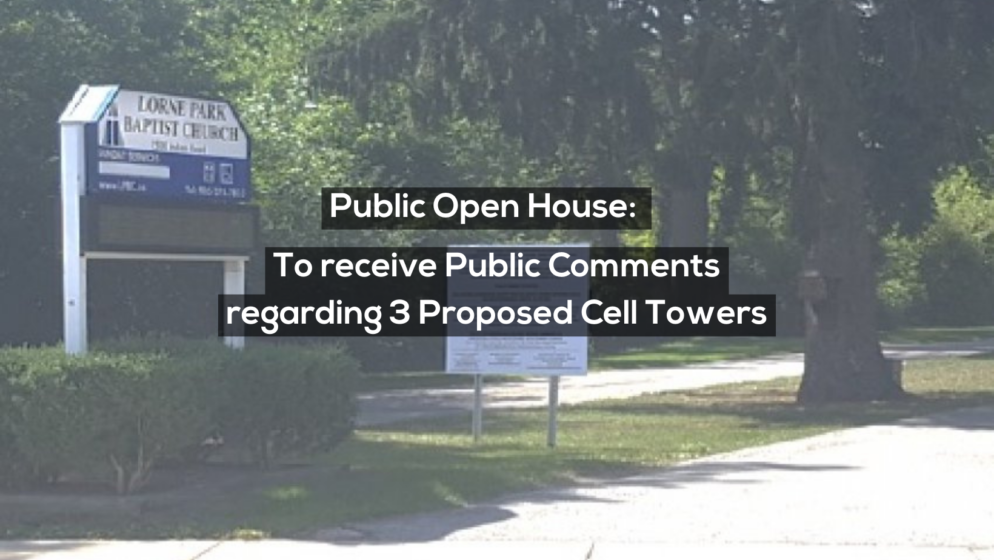
Public Open House:To Receive Public Comments Regarding 3 Proposed Cell Towers

Important Reminder from Concerned Residents of Lorne Park:

Shared Network Canada (cell tower owner) and The City of Mississauga is hosting a PUBLIC OPEN HOUSE to receive public comments regarding 3 proposed cell towers located at Lorne Park Baptist Church.

This is the neighbourhood’s opportunity to voice their questions and concerns directly to Shared Network Canada (private cell tower owner) and the Municipality (Ward 2 Councillor Karen Ras & City of Mississauga Planning Dept.)

Please plan to attend!

Thursday September 17th, 7:00pm @ Lorne Park Hall – 1288 Lorne Park Road.

www.facebook.com/groups/stopLPcelltowers

Email: stopLPcelltower@gmail.com