DO ALL REAL ESTATE AGENTS CHARGE THE SAME FEE?

Asking whether all real estate agents charge the same fee is like asking if Rolex and Timex are made the same way. Every Realtor is different and offers a wide variety of differing services and skill sets. Therefore real estate fees and commissions vary to a large degree.

In the province of Ontario, it is against the law for a Realtor to price fix. This gives the home seller the ability to discuss and negotiate the fee.

Real estate commissions are all over the map and so are the services the real estate agent can offer. Homeowners are encouraged to clarify what services are included in the real estate commission.

All home sellers should budget accordingly for their home sale. Real estate expenses such as lawyer fees and moving costs should also be considered. Your real estate broker should be able to share estimations with you.

If you think your home is tax deductible or has tax deductions, it’s best to speak to an accountant beforehand.

Hidden Traps of Realtor Advertising

Some real estate teams claim to have big advertising budgets and to do a lot of marketing. And many of them do. However, does their form of advertising benefit you, the home seller?

Often, the marketing budget is spent on advertising the Realtor so that they can get new business and sell other houses.

When selecting a Realtor make sure to study their real estate advertising and marketing habits. Does an advertisement claim their number one in a given the old or are they spending the marketing dollars on text that relates to drawing a buyer to your home?

Real estate agents make money off of developing leads. In turn, they take the lead and sell a home to another buyer. It’s important that your home is being marketed and targeted to the appropriate audience that is going to bring you the best price for your home.

Beware of agents that charge a flat fee for service. That could allude to the fact that they are not investing in the process. On the other hand, agents who charge a high fee but only advertise themselves with the hopes of getting a real estate lead, do not necessarily help you.

Agents that charge a low fee and insist on doing open houses may have a hidden agenda. You don’t want your house to become a store for that agent to pick up buyers that are not qualified to buy your home.

Why Do Real Estate Costs Differ Amongst Brokers?

Similar to the Rolex/Timex comparison, there are a lot of differentiators amongst real estate professionals. Like the old saying goes, you often get what you pay for.

Simply put, if you hire a full-time, full-service broker, you can expect many extra services that a low fee-for-service agent just cannot offer.

Like everyone in business, Realtors have expenses, such as home staging services to professional home improvement costs. Real estate marketing and advertising make up a large part of expenses.

As a home seller, if your goal is to maximize the price of a sale in the least amount of time, one needs to expose the home to the greatest number of qualified buyers. How do you do that? You need an agent who invests in the process.

Banks charge interest rates on mortgages so they can make a profit. Realtors charge a commission to cover their expenses and to make a profit. A profit for their ability to negotiate and for their tenure in the industry brings experience to the homeowner.

How Much Does It Cost to Sell a Home?

This answer usually lies in the quality of service a real estate agent is offering to the home seller. There are many moving parts and expenses to getting a home sold that a real estate brokerage takes on.

Generally speaking, a Realtor with a big advertising budget can increase the chances of getting a home in front of more qualified buyers.

What Costs Should a Home Seller Expect Beyond a Commission

Every home is different and therefore will have varying expenses including home staging and painting before going to the MLS or Realtor.ca. Some home sellers should consider having their home inspected prior to listing. This avoids any surprises later and can be done by a home inspector.

Property taxes should be brought up to date to avoid headaches on closing. Capital costs such as home renovations should be thoroughly talked through with a local Realtor and stacked up against other homes for sale in the area.

Repairs and maintenance are just parts of owning a home and a good seller’s agent will be able to distinguish between what should be improved and what is not necessary.

Sometimes in the commission rate the Realtor will play a hand in organizing and paying for minor repairs. If you’re going to sell your house, it’s often with the minor repairs.

Keep in mind real estate expenses such as lawyer fees and moving expenses. If you’re moving down the street versus across the country, costs can vary dramatically.

Most lawyers include in their fee ledger land transfer tax and title insurance. Make sure to get a breakdown from your lawyer ahead of time. Some sellers will need it for tax returns or income tax purposes.

If you have been receiving rental income from your home, you might consider speaking to your accountant. Also, if you buy and sell frequently, CRA may deem the net proceeds from your sale as income.

Advice in a Nutshell

  • Not all Realtors are the same and neither are their fees
  • Real estate fees and commissions are negotiable
  • You generally get what you pay for
  • It takes money to make money so if selling for a high price is important, make sure to choose an agent with a large marketing budget

Talk of the Town

The real estate market has been the “talk of the town” in recent months and why shouldn’t it be? Not only does it affect us all, but from the standpoint of owners and renters, it accounts for roughly $141.5 billion in gross domestic product (GDP).

The market experienced price growth at a torrid pace in 2021, with Canadian average housing prices peaking at just over $800,000. In 2023, the MLS® Home Price Index (HPI) climbed 1.1% month-over-month and was down just 1.5% year-over-year.

The Bank of Canada needed to get inflation under control and, in order to do so, they began to raise interest rates—the cost to borrow money. By making it more expensive for businesses and consumers to borrow money, the BoC essentially wanted the general population to stop spending money at the rate we were, which was driving up the cost of goods and services.

However, when rates go up, historically this puts downward pressure on home prices. Since the increase in interest rates, we have surprisingly seen prices hold relative to the increase. The actual (not seasonally adjusted) national average sale price posted a 6.3% year-over-year increase in July

The real problem has been in the number of units sold. With rising interest rates, it takes time for the market (buyers) to normalize and adjust to the rate increases. A recent report by Matthew O’Neil at Connolly Capital Mortgage Solutions shows the number of mortgage originations over the past decade.

O’Neil says, “We are now (once again) waiting for the next pause, or better yet a pivot to the consistent upward pressure on interest rates.”

Since July, the market has seen a pause but with the seasonal fall market around the corner, this is a busy time for buyers and sellers as holidays come to an end and kids go back to school.

Look for the market to pick up steam as we close out the year. Pent-up demand from the pandemic is still there with first-time home buyers itching to enter the marketplace. People are always downsizing, upsizing and job and socio-economic factors are always at play as part of someone’s decision to buy, sell, or invest in real estate.

In the mid-to-long term, elevated rates will put pressure on households who will see a drastic increase in mortgage payments from what they’re used to paying. If you locked in on a fixed mortgage three years ago, that payment could drastically increase in a few years when the renewal comes up—assuming rates stay close to where they are today.

According to Connolly Capital, it is estimated only one-third of mortgage holders have felt the effects of higher rates. For those renewing their mortgages in 2024 and beyond, payment increases are expected to reach at least 15%. In the GTA, these numbers will be even higher due to larger mortgage sizes. As time goes on, these changes will affect more and more mortgage holders simply by default their term coming due and being faced with the reality of higher rates.

The good news for buyers is the market may see more inventory. Tertiary markets will benefit as people may be forced to downsize their homes and move outside the GTA to markets that are more affordable.

Whether all of this reduces the cost of housing is anyone’s guess. We still have pent-up demand, large immigration numbers, and not enough housing to meet demand.

Where to Invest in a Fresh Coat of Paint

f you are thinking of selling your home, you may want to consider a fresh coat of paint. Paint goes a long way in transforming a home from mundane to inspiring and improving its saleability along the way! It’s proven that (done correctly) your home will sell for more money in fewer days on the market.

When it comes to a fresh coat of paint, it’s not just the walls that could use it. Try these ideas on for size:

Exterior Brick or Siding

Colour is as important to your home’s exterior as its interior. But exterior colour is usually applied in the form of siding, trim and roofing—a far more permanent investment than wall paint or accessories. With a little colour know-how, you can pick the perfect colour scheme for your home’s exterior, one that reflects your tastes and your home’s architectural style. Try painting brick or stucco a more modern colour to give your home a low-cost makeover.

Approximate Cost: $1,500-$3,000

Front Door and Mailbox

Sometimes, all you need to do is complete a small, inexpensive update to fall in love with your home all over again. By painting an exterior door a vibrant colour, you can enhance your home’s curb appeal and it’s easy to change for future updates or owners.

Approximate Cost: $100

Ceilings and Trim Work

Often painted white. Don’t forget baseboards, crown mouldings and the trim around windows and doors.

Approximate Cost: $500

Painted Fireplaces

Painting a fireplace can be a fun project when you want to change the look of your fireplace area. It can add a fresh new look to your home and can make the overall room more inviting for friends and family.

Approximate Cost: $300-$500

Kitchen and Bathroom Cabinets

With the high cost of re-facing or replacing faded or dated kitchen cabinets, painting them is a great option. Done correctly, this can make a dramatic difference to one of the most used rooms in a house.

Approximate Cost: $400-$600

Stair Banisters and Spindles

A coat of white paint to the spindles and black on the banister adds life to a tired and dated staircase. Consider adding a carpet runner to really make it stand out.

Approximate Cost: $500-$1,000

Walls

Changing the colour scheme in a room is the fastest and least expensive decorating touch on the market. It enhances the room’s appeal and, simply put, is the best bang for your buck.

Approximate Cost: $300-$500

That Old Piece of Furniture

Sometimes old furniture is a necessity. Sometimes it’s just fun. Older pieces can make a new style statement, provide economical storage and extra seating or continue a family tradition. Add freshness, style and charm to old furniture with new paint. Consider accenting it with new hardware.

Approximate Cost: $75

source: www.livelovediy.com/2012/04/how-to-paint-trim.html

Real Estate Brokerage Fees Explained

If you are selling your home, you should know how real estate brokerage fees work. In the province of Ontario, there are no hard and fast real estate fee rules.

With one exception. Price fixing is not allowed which means there is no manual explaining how real estate fees work. Here it is in simple terms.

How Are Real Estate Fees Determined?

Real estate fees are most often a percentage of the sale price of a home. Which is kind of cool because the more money a Realtor can sell your home for, the better for everyone involved. In other words, the percentage model incentivizes a real estate agent to get higher prices for the seller.

Are There Other Ways Realtors Charge?

In other models, there is a flat fee for service. Though not as prevalent, flat fee models usually are just that. Sometimes based on the real estate brokerage business model, a single price or tiered pricing based on what the seller wants from the brokerage they have selected to help them sell a house. In Ontario, this is less common than in other western provinces.

How Does My Realtor Get Paid?

What’s important to know is there are usually two sides to the transaction. The listing brokerage side (represents the home seller) and cooperating broker aka the buyer’s broker (represents the home buyer). Both parties get paid and it’s usually handled on the listing brokerage side.

When the seller signs a listing agreement with a brokerage to sell their home, the listing brokerage discusses with the seller how much their fee is and a discussion of how much to offer the buyer’s broker as an incentive to bring buyers. These are not fixed costs so you are best to discuss this with your listing brokerage as soon as you meet with them to discuss the selling process.

How Do I Determine What Commission To Offer The Buyer’s Agent?

I had a client once who described through her lens how she viewed the buyer’s brokerage incentive fee. She said it was like buying insurance.

Though agents are not allowed to discriminate against a lower fee and not show a particular home, agents are human. And Humans are driven by incentives. Consult with your local agent beforehand and ask what the going rate being offered is in your marketplace.

Do All Realtors Charge The Same Fee?

Real estate fees are all over the map. There are no two real estate brokers that are the same and all of them provide different services such as how they market and advertise your home. Home staging, decluttering services, home improvement contacts are but a few of the services a full service broker can offer. Needless to say, these services cost money.

How Do I Choose The Best Broker For My Needs?

A seller is advised to choose a broker that best meets their needs. Oftentimes a real estate agent has trusted contacts that have worked with other clients in the past. This can bring assurances and trust to the decision of whether to apply these services to your needs.

If selling your home for the most amount of money is important, then remember, you often get what you pay for. A low service fee agent will provide just that, oftentimes low service. On the other hand, A real estate brokerage that charges a high fee better be able to back up why they do so. Often these answers and a clear decision is made when interviewing and understanding what the Realtor provides.

How Long Does It Take To Sell My House?

There are many factors that determine how long a house might take to sell. A low-fee agent may put your home on the MLS (multiple listing services) website and wait. Also referred to as a passive agent.

Sticking to the theme of you get what you pay for, a higher service fee agent will expose your home on more websites to more potential buyers. Generally speaking, the more people that know your home is for sale, the more likely you are to sell it quicker and for more money.

Advice In A Nutshell

  • Do your homework
  • Meet with an agent that you feel can best deliver on your needs
  • Be wary of discount brokers
  • You get what you pay for
  • What may feel like savings on fees could cost you more in the long run if the sale price is not maximized

Do I Get A Better Deal If I Buy A Home Through the Listing Agent?

There is an often misinterpreted myth in the real estate world amongst would-be home buyers that if they offer on a house for sale to purchase, they will get the home at a lower home sale price if they use the listing real estate broker.

Understanding The Listing Agreement Between the Home Seller and Listing Brokerage

The listing agent (Listing Brokerage) has a Listing Agreement with the seller of the home. Which means they have a fiduciary duty to the seller to act in their best interest throughout the home selling process – including the negotiation of best terms and price in favour of the seller.

Some fiduciary duties are: 

  • undivided loyalty to the client
  • acting in the best interests of the client at all times
  • the duty to avoid all conflicts of interest the duty to disclose all conflicts of interests when present

A buyer has the right to pick any licensed real estate agent of their choosing. It does not have to be the listing broker who represents them when submitting an offer to purchase. 

Some listing brokerages will charge a low commission or give a better commission rate if they can bring their own buyer. As a home seller just be careful that does not interfere with your best interests. 

What Fiduciary Duty Is There To A Buyer

When a home buyer engages a Realtor to purchase a home, they must sign a number of provincially regulated forms.

These forms spell out the fact that if the home buyer uses the home seller’s agent to purchase the home, the Realtor representing the seller as an obligation to the home seller to protect their best interest.

This type of situation is what’s known as dual agency or multiple representation. This can create a conflict of interest if the rules are not followed during the real estate transactions.

In most dual agency situations, the duty is to the seller and not to the buyer.

Are You A Home Buyer That Prefers To Deal With The Listing Agent?

If you’re a home buyer that just prefers dealing with the listing agent, not necessarily looking to get a better deal, you should know what your rights are.

Under the Real Estate Council of Ontario’s code of ethics, there are certain things that a realtor should explain to you. One of the forms you will sign is called working with a realtor as well as a buyer representation agreement. These forms are in place to protect a buyer’s rights.

There are two types of representation that a buyer could seek. Although the terms “client” and “customer” are typically used synonymously in some businesses, they mean different things in real estate transactions and can have separate implications for a potential buyer and seller.

Make sure when you engage the listing agent that that listing agent has made clear to you what type of representation they will offer to you.

When Does A Conflict Of Interest Arise

Most conflicts of interest arise when a homebuyer interacts with the listing agent who already is under contract with a home seller. The conflict of interest usually lies around negotiating a better price for the buyer.

In a real estate deal, there is a purchaser and there is a seller. They have opposing interests. 

As a home buyer it’s important to know what your rights are so ask a lot of questions to the agent before submitting an agreement of purchase and sale to a home seller.

An ethical agent will follow the Real Estate Council of Ontario rules and regulations. They will walk you through the necessary paperwork and explain to you what the different types of representation you are entitled to. 

An ethical agent will also explain to you what the listing agreement actually means as it pertains to their obligation to the seller.

Included in the listing agreement is the real estate fees and how the Realtor and Listing Brokerage get paid. 

Advice In A Nutshell

  • Nowhere in any of the documents to be signed does it say the buyer stands a chance of getting a better deal.
  • In fact, it is the opposite as the listing agent’s fiduciary duty is to the seller
  • A home buyer should understand what the difference between customer service is and client
  • A realtor is held to a strict code of ethics governed by The Real Estate Council of Ontario and other provincial jurisdictions. 
  • If the listing real estate agent is found to be in a conflict of interest, an ethical agent will always default to their fiduciary duty to the seller 

The Future of Real Estate Investing

More than 1 in 4 Canadians plan to purchase an investment property in the next five years: Royal LePage Report

51% of current investors and 23% of non-investors are considering buying an investment property before 2028

Survey highlights:

  • Approximately 4.4 million Canadians currently own an investment property
  • 26% of all Canadians say they are likely to buy an investment property within the next five years
  • One third of Canadian real estate investors (32%) own two or more properties
  • Younger investors, those aged 18 to 34, are more likely to own more than one investment property compared to their older counterparts (aged 35+)
  • 15% of Canadian residential investors do not own their primary residence; the majority of whom are aged 18-34
  • Nearly one third of investors in Canada (31%) have considered selling one or more of their investment properties due to higher lending rates

According to a recent Royal LePage survey[1] conducted by Leger, 11% of Canadians—that’s approximately 4.4 million people[2]—currently invest in residential real estate. 64% of residential real estate investors own one property, and 32% own two or more.

Despite higher borrowing costs in today’s post-pandemic real estate environment, the aspiration to own property for the purpose of investment remains strong. 23% of Canadians who do not own a residential investment property say that they are likely to purchase one in the next five years, and more than half (51%) of current investors say that they are likely to purchase an additional residential investment property within the same time period. Overall, more than a quarter of all Canadians (26%), current investors or otherwise, plan to buy an investment property before 2028.

Young Canadians ‘more inclined than ever’ to invest

Although many young Canadians are struggling to get a foot on the property ladder, the youngest group of real estate investors, those aged 18 to 34, are the most likely to have more than one residential property compared to their older counterparts. 44% of the youngest investor cohort own two or more investment properties, significantly higher than those aged 35 to 54 (29%), and those 55 or older (25%). Of particular note, 67% of younger investors (18-34) own their primary residence, compared to 88% and 95% of investors aged 35-54 and 55 or older, respectively.

“We know that the value of home ownership is strong among Canadians—it is clear that possessing real estate remains a desirable means for building wealth over time. Many choose to invest in real estate not only as a way of generating income and reaping the benefits of value appreciation, but to provide an opening into the market for future generations of their family, ” said Phil Soper, president and CEO, Royal LePage.

Location, amenities and property type still valued among investors

Across Canada, single-family detached homes are the most popular type of investment property, with 44% of real estate investors owning this type of home. Condominiums are the second-most popular type of investment (37%), followed by townhomes (11%). According to the survey, Canadian real estate investors report that the opportunity for property value appreciation over the long term (69%), positive cash flow on a monthly basis (54%), and low maintenance costs or variable expenses (44%) ranked as the top three priorities when buying their residential investment properties.

“While much of the emotion is removed from the buying process of an investment property compared to purchasing a home for personal use, investors value many of the same characteristics, such as location, local amenities and property type,” continued Soper. “Many real estate investors extend their search into more affordable markets, and are prepared to take on the additional commitment of owning property beyond the region in which they live to cash in on the financial benefits.”

15% of residential investors do not own their primary residence—12% of investors rent, the majority of whom are aged 18-34, while 3% live rent-free with family or friends.

“I find it interesting that a material number of investors do not own the home they themselves live in. Many of these people have likely invested in a more affordable city than the one they live in,” added Soper. “This tactic demonstrates Canadians’ deep-seated belief that real estate is a worthwhile long-term investment.”

Investor finances amid global economic uncertainty

The increased cost of borrowing has had a significant impact on variable-rate mortgage holders in Canada over the past year, and those with investment properties have also been feeling the effects. Increased lending rates have caused nearly one third of investors (31%) to consider selling one or more of their properties. Investors aged 18 to 34 are the most likely to weigh the decision of selling at least one of their investment properties (54%).

Looking to the future, 44% of investors say they intend to keep their investment property or properties in their current state over the next two years. During the same time period, 26% of investors plan to renovate one or more of their investment properties, while 24% are planning to sell one or more of their homes.

“Investors play a pivotal role in supplying much-needed housing units to renters across the country, and will continue to be an important part of the Canadian real estate ecosystem as the nation welcomes an unprecedented number of immigrants in the coming years,” said Soper.

The Weigh Scale Approach to Decision Making

Would you like to capitalize on this incredible real estate market but aren’t sure if it’s the right time? Well, get in line. There are a lot of homeowners right now that tend to feel trapped. Not in the literal sense, of course, but from the simple standpoint of, ”It’s not the right time.”

Recently, we helped a family make a difficult decision on whether to sell now or wait a few years until their kids had graduated high school. Another family we helped wasn’t sure whether to wait two more years until their retirement. And yet another family we helped were recent empty nesters and weren’t sure whether to keep the house for when the grandkids came to visit. These are just a few classic examples of decisions families had to make when balancing the value of the emotional and economic situations. Is now the time to capitalize on the equity that you’ve built in your home through a hot real estate market?

The families mentioned were able to make an educated decision via the Scale Approach. Picture a weight scale. On one side of the scale is where you place the emotional factors. On the other side you place the economic factors. After you’re done weighing the factors, the side that weighs the most may be your answer.

We’re here to help! The Regan Team specializes in helping families make tough decisions. It’s never too early to start planning. The first step is making the phone call to set up a 45-minute meeting. In that meeting, we need to address a few things, regardless of whether or not you’re selling tomorrow or in five years.

  1. What is the value of my home today? Like an annual check-up with the doctor, it’s good
    to have a yearly check up on your largest asset. You may be pleasantly surprised.
  2. What low cost improvements can I make to increase the value of my home before I put
    it up for sale? For example, a dollar spent on a coat of paint can increase your margin by
    five times when selling.
  3. Last, but not least, let’s talk about a game plan. A good game plan is the foundation to
    good decision making. And we have tons of experience in tried and tested game plans.

Here are a few ideas that we’ve heard from others in your position.

Emotion:

  • My kids are still in school
  • My grandkids want to visit
  • The dog needs a backyard to run in
  • I’ve been in my home for years
  • Close to familiar amenities
  • Proximity to work

Economic:

  • My house is worth more money than ever
  • I like the idea of selling for maximum profit and putting some cash in my pocket
  • I can now afford to accomplish my goals and live my dreams
  • I’ve built incredible wealth through owning my home
  • Maybe now I can afford to help family and friends
  • Simplifying my life sounds good

Affordable Do It Yourself Home Improvement

Whether you’re looking at selling your home or just want an inexpensive burst of life injected into your space, we have compiled some ideas to help you.

Thanks to our friends at Paintscapes, you can save on Benjamin Moore products to make your project not only come to life but save you some money along the way.

Download a free PDF of our Exclusive Offer and Our Affordable Do It Yourself Home Improvement guidelines.

What No Real Estate Agent Wants to Be Asked in an Interview

The 1 Question Every Home Seller Should Ask Their Real Estate Agent:

You have made a decision to sell your house. You’ve been in your home for years and the thought of selling your home is daunting. There are so many things to consider and the anxiety is piling up high.

Don’t worry, there are hundreds of real estate brokerages out there that can help you. Ontario alone has over 70,000 licensed real estate agents.

However, with so many options to choose from, selecting the best Realtor to represent you can be daunting.

Doing your due-diligence at the beginning of the process is very important in selecting the right real estate brokerage to represent you.

It’s important that the Realtor is not too busy to handle your needs. Afterall, you want a successful home sale. Understanding how the agent operates and what other obligations beside your sale they have on their plate can help you make the right decision.

There may be other homes for sale in your neighbourhood that you are competing against. You may need to get your home inspected prior to sale. Finding red flags before you sell your house is important. Real estate agents can help with this—if they have time.

How Do You Know How to Select the Right Real Estate Agent?

Selecting the right real estate broker can be a daunting task. Understanding their business model is key. In order to do so, as the homeowner, you must ask questions and do your homework.

Reading a Realtors Facebook and Google reviews is important. Watch out for fake reviews and concentrate some of your time on the negative reviews. Look for key words, like selling price and the person’s experience.

Is the real estate agent an independent or solo agent? Are they the team leader responsible for a big team? Is it a husband and wife duo?

All of these come with pros and cons. It’s important, as a home seller, to do your homework and understand what is best for you.

Asking the Big Question

If you only ask one question, ask the real estate agent you’re interviewing what their business model is. This will give you an insight and a look into the future to see how your sale may go.

An independent real estate agent wears many hats. Though they try to promise one-to-one service, and many do a good job at it, they may lack other resources, such as a marketing team, digital ad management and social media expertise.

A team leader wears many hats. Hiring and firing. Payroll and accounting. Marketing and advertising.

More often than not, a team leader will struggle to devote the appropriate amount of time and attention to detail required to complete a successful sale.

A balanced business model is probably best. Such an agent will have the time to dedicate to your home sale by finding a home buyer, speaking with agents and securing the best price for your home.

They can do this because they have an organized marketing team behind the “A Team” of specialists that answers the phones, manages employees and looks after other important day-to-day tasks.

After You Ask the Question, How Will You Know You Got an Honest Answer?

You will know you got the right answer by following a few steps:

  1. Look on the agent’s website.
    1. How many listings are they carrying at any given time?
    2. How many agents and support staff are listed?
  2. What is the role and responsibility of the agent you are interviewing?
    1. Are they busy managing admin and support staff?
    2. Do they have a large number of agents they are responsible for managing?
  3. Can they clearly define their business model?
    1. Ask them to define it.
    2. A red flag should go up if you’re not convinced you’re going to get the attention you deserve.

Picking an Agent

There are other filters available to you that could help you make a decision when it comes to picking a Realtor. When selecting a Realtor, ask:

  • What interest rate environment are we in right now?
  • Are monthly mortgage payments a factor for buyers when they look at my home?
  • What price range can I expect my house to sell in?
  • Are flat-fee services better than percentage-based service fees?
  • Are first time homebuyers a factor in my market place?
  • What services do I receive for the commission rates charged?
  • What is included in your real estate fee?
  • Is this person amongst the top real estate agents in my local market?
  • Can you explain the land transfer tax?
  • Does a buyer have any tax credits they can use when selecting my house?

By asking some of these questions, selecting an agent will be easier, as you’ll gain insight as to whether this Realtor knows their stuff.

Advice in a Nutshell

  • Do your homework before interviewing an agent
  • Be wary of agents with big team rosters
  • If they carry a lot of listings, will they have time to devote to your needs?
  • If they cannot communicate their business model in a way that benefits the home seller, be careful

Here We Go…Again

I’m going to make a bold statement…The real estate market has caught fire again!

For the past 8 to 12 months the real estate market has been in a dormant state. Like someone turning off a light switch the moment the Bank of Canada (BoC) started to raise interest rates, the real estate market has been dormant. Buyers that were competing against dozens of other offers in 2021 and the first quarter of 2022 to buy a house, all of a sudden were on the sidelines.

The cost of borrowing money in the form of a mortgage felt like it doubled overnight. Why would anyone buy a house with no end in sight on rising interest rates? Well, again, like a light switch, the moment the BoC said they would halt rate hikes for the remainder of 2023, there was a spike in the demand for real estate.

“There has been nothing ‘typical’ about Canada’s housing market since the start of the COVID-19 pandemic. Lockdowns brought the housing market to a grinding halt in early 2020 before the work-from-home revolution catapulted it into a two-year, all-season frenzy of record sales volumes and aggressive price growth,” said Phil Soper, president and CEO of Royal LePage. “As markets do, this market overshot, and the inevitable correction was triggered when the Bank of Canada began to rapidly raise interest rates. The downturn came swiftly, and the real estate industry remained depressed for 12 months. We have turned the corner and the housing economy is growing again; none too soon for many buyers, who have been waiting patiently for prices to bottom out.”

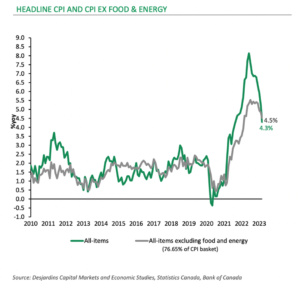
More good news is on the horizon, as this is the first time we have seen inflation reports that begin with a “4,” since 2021. And with lower inflation comes lower interest rates. Think of interest rates as either the gas pedal to price appreciation or the brake pedal, which lowers demand and thus reduces value.

Unless we see something drastic happen in Canada’s economy like a surge in crude oil prices or another surprise event, the Bank of Canada is predicting 3% inflation by this summer. Though still considered high when compared to an inflation target in the 2-2.5% range, this is good news when coming off a high of 8%.

A recent Royal LePage survey found that nearly one quarter of Canadians (24%) were in the market for a new home over the last year, and 63% of them said they postponed their plans due to rising interest rates. Of those who put their plans on hold, 26% said they plan to resume their search this spring, and another 36% said they would return to the market in the near future, once the Bank of Canada holds rates for several consecutive months.

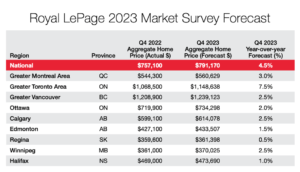
Royal LePage is forecasting that the aggregate price of a home in Canada will increase 4.5% in the fourth quarter of 2023, compared to the same quarter last year. The aggregate price of a home in the Greater Toronto Area decreased 11.8% year-over-year to $1,119,900 in the first quarter of 2023. On a quarterly basis, however, the aggregate price of a home in the GTA increased 4.8%.

While sales are way down in the Greater Toronto Area compared to the record highs reported in the first quarter of 2022, on a month-to-month basis, sales were up 54% between January and February, and 44% between February and March; and new listings were up 9% from January to February, and 34% February to March.

Royal LePage is forecasting that the aggregate price of a home in the Greater Toronto Area will increase 7.5% in the fourth quarter of 2023, compared to the same quarter last year. The previous forecast has been revised to reflect current market conditions.

If you have found this information to be as clear as mud, please reach out. We’re here to help. And please remember, the real estate market is big. The neighbourhood and street you live on is small. There are many factors that go into the price of a home and we can help with that.

Source: Royal LePage and Connolly Capital Mortgage Solutions