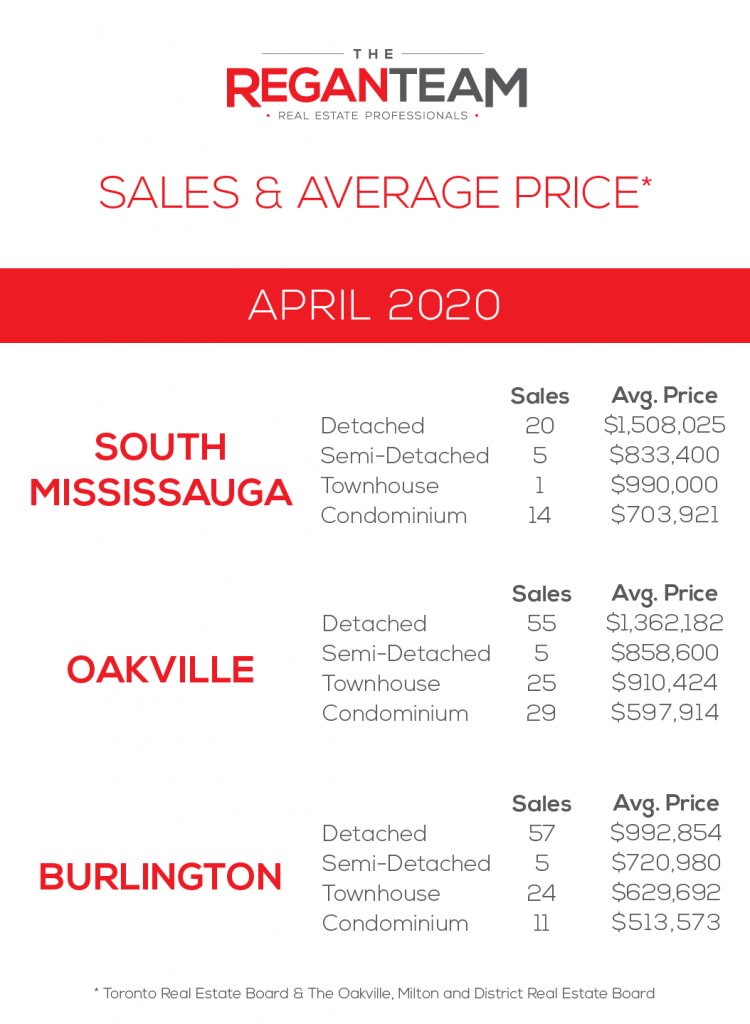
Real Estate Market Update: April 2020

After a stellar 1st Quarter of real estate activity in the GTA that suggested a record-breaking spring market was in store, the Coronavirus pandemic and resulting government health and safety measures abruptly changed everything. As expected, social distancing orders have quieted the market. TREB’s April 2020 statistics show the initial impact of COVID-19 with sales and new listings dropping 67% and 64% respectively year over year for all property types, the largest declines on record. However, due to the continuing demand on the GTA’s already low inventory, prices remained consistent with those in April 2019. Canadian economic forecasters are in general agreement that the risk of a sharp price decline is low near term, and that price support will continue to soften gradually in the weeks ahead, although not enough to threaten the stability of the market. With employment being a key driver of house prices, this will be an important statistic to watch as the economy reopens.

Royal LePage Market Forecast: National Home Prices to Show Remarkable Resilience in 2020

  • Best case scenario forecast shows Canada’s aggregate home price could grow a modest 1% by the end of 2020
  • If the pandemic continues to heavily restrict business activity through late summer, a national home price decrease of 3% is expected by the end of 2020
  • The aggregate price of a home in Canada climbed 4.4 per cent year-over-year in Q1 2020
  • High demand and low inventory in Toronto, Montreal and Ottawa fueled rising home prices

TORONTO, April 14, 2020 – According to the Royal LePage House Price Survey and Market Survey Forecast released today, the aggregate[1] price of a home in Canada is expected to remain remarkably stable through the COVID-19 pandemic.

If the strict, stay-at-home restrictions characterizing the fight against COVID-19 are eased during the second quarter, prices are expected to end 2020 relatively flat, with the aggregate value of a Canadian home up a modest 1.0 per cent year-over-year, to $653,800. If the current tight restrictions on personal movement are sustained through the summer, the negative economic impact is expected to drive home prices down by 3.0 per cent ($627,900) year-over-year. In December 2019, Royal LePage forecast the national aggregate price to increase 3.2 per cent by the end of 2020. Due to COVID-19, expected price growth has been revised down almost 70 per cent compared to Royal LePage’s base scenario.

“The impact of COVID-19 on the Canadian economy has been swift and violent, with layoffs driving high levels of unemployment across the country. While it is sad that these people skewed strongly to young and to part-time workers, for the housing industry, the impact of these presumably temporary job losses will be limited as these groups are much less likely to buy and sell real estate,” said Phil Soper, president and CEO, Royal LePage. “From our experience with past recessions and real estate downturns, we are not expecting significant year-over-year price changes in 2020. Home price declines occur when the market experiences sustained low sales volume while inventory builds. Currently, the inventory of homes for sale in this country is very low, matching low sales volumes as people respect government mandates to stay at home.

“It is easy to mistakenly equate a handful of transactions at lower prices to a reset in the value of the nation’s housing stock. Distressed sales that occur during an economic crisis are a poor proxy for real estate value,” said Soper.

Broad-based measurements of industry activity point to a sharp decline in the four or five weeks since all provinces declared states of emergency. Home search activity on popular real estate websites are down more than 20 per cent versus norms. Home showings are down by more than two-thirds, based on Royal LePage sampling. Open house gatherings of people at a property for sale have been reduced to almost zero nationwide.

“As we ease out of strict stay-at-home regimens, sales volumes will return; traditional home sales practices will not,” continued Soper. “The popular ‘open house’ gathering of buyers on a spring afternoon is gone, and it won’t be coming back any time soon. The industry is leveraging technologies that allow a home to be shown remotely and social distancing protocols, where we restrict client interaction with our Realtors to limited one-on-one or two meetings, will continue for months and months. This process is inherently safer than a trip to the grocery store.”

The aggregate price of a home in Canada increased 4.4 per cent to $655,276 in the first quarter. When broken out by housing type, the median price of a two-storey home rose 5.1 per cent year-over-year to $770,005 while the median price of a bungalow and condominium rose 2.1 per cent and 4.4 per cent to $541,040 and $493,917, respectively. Price data, which includes both resale and new build, is provided by Royal LePage’s sister company RPS Real Property Solutions, a leading Canadian valuation company.

At the start of 2020, Canada’s housing market was experiencing a surge in home sales with growing upward pressure on major market home prices. This resulted from pent up demand that was released in the second half of 2019 when federal mortgage stress test measures implemented in 2018 had largely been absorbed by the market and consumer confidence began to build.

“If the fight against the coronavirus requires today’s tight stay-at-home mandates to remain in place for several months more, with no semblance of normal business activity allowed, temporary job losses will become permanent and consumer confidence will be harder to repair,” said Soper. “This would place downward pressure on both home sales volumes and prices.

“Equally, if the collective efforts of Canadians slow the spread of the disease to manageable levels, and if promising science and therapeutic drugs are announced, people will return to their jobs, market confidence will bounce back quickly, and we could see Canada’s real markets roar back to life, with 2020 transactions delayed but not eliminated.”

REGIONAL SUMMARIES

Greater Toronto Area

Housing demand outstripped supply in the Greater Toronto Area putting significant upward pressure on home prices. During the first quarter of 2020, the Greater Toronto Area aggregate home price rose 7.5 per cent year-over-year to $866,211.

When broken out by property type, the median price of a condominium saw the highest appreciation, rising 8.8 per cent year-over-year to $580,508. The median price of a two-storey home and bungalow rose 7.7 per cent and 3.7 per cent to $1,010,004 and $826,186, respectively.

“Toronto real estate appreciated rapidly in the first quarter as the demand that began in the second half of 2019 kept its momentum while inventory remained low. However, by mid-March both buyers and sellers had pulled back to adhere to social distancing measures and gauge the impact of the pandemic on the market,” said Kevin Somers, chief operating officer, Royal LePage Real Estate Services Limited.

If business activity resumes by the end of the second quarter, the Greater Toronto Area may see a year-over-year increase of 1.5 per cent to its aggregate home price by the end of 2020, increasing to $861,100. If business activity resumes in late summer 2020, the region could see a decrease of 0.5 per cent year-over-year in aggregate home price to $844,200.

Greater Montreal Area

During the first quarter of 2020, the Greater Montreal Area aggregate home price rose 7.2 per cent year-over-year to $441,979, representing the second consecutive quarterly year-over-year record increase in almost a decade. However, a decline in sales and new listings was observed in mid-March due to COVID-19.

When broken out by property type, the median price of a two-storey home and bungalow rose 8.0 per cent and 6.9 per cent year-over-year, respectively, to $557,594 and $344,043, while the median price of a condominium rose 5.0 per cent year-over-year to $344,962.

“Historically, the financial and real estate crises of the past 50 years that have disrupted consumer confidence and the number of real estate transactions have had little effect on property prices when analyzed over a 12 to 18 month period,” said Dominic St-Pierre, vice-president and general manager, Royal LePage, Quebec region. “While sales will temporarily slow down during the current pandemic, we do not foresee a significant decline in home prices, at least not for a sustained period, as housing and shelter is an essential need. Additionally, we expect that the numerous buyers who have put their purchase on hold will create a surge from pent-up demand,” he added.

If business activity resumes by the end of the second quarter, the Greater Montreal Area real estate market should remain relatively stable, with a year-over-year decrease of 0.5 per cent to its aggregate home price by the end of 2020, decreasing to $434,500 by the end of 2020. If business activity resumes in late summer 2020, the region’s market could see a decrease of 3.5 per cent year-over-year in aggregate home price to $421,400. This forecast factors in that Quebec is the only province in Canada where real estate brokerage is currently not included in the list of essential services.

Greater Vancouver

Despite tightening inventory and a surge in sales, the aggregate price of a home in Greater Vancouver decreased 2.1 per cent year-over-year to $1,083,166 in the first quarter of 2020.

Broken out by housing type, the median price of a two-storey home decreased 1.1 per cent year-over-year to $1,402,395, while the median price of a condominium and bungalow decreased 2.5 per cent and 4.2 per cent to $636,012 and $1,182,420, respectively.

“While the region had not quite returned to the 10-year average in home sales, the Greater Vancouver housing market was on a path for a vibrant spring market. We were seeing consumer confidence grow from the healthy demand seen in the entry-level segment that was extending upwards through the mid-range properties. We expected this upward trend to continue,” said Randy Ryalls, managing broker, Royal LePage Sterling Realty.  “Amid COVID-19 concerns, Greater Vancouver’s real estate activity began to slow in mid-March. While we do not know the duration of the pandemic, demand is still there and waiting for regular market activity to resume.”

The aggregate price of a home in the City of Vancouver rose 1.0 per cent year-over-year to $1,245,608 in the first quarter of 2020, driven by a gain of 4.9 per cent in the median price of a two-storey home. Both the median price of a bungalow and condominium declined year-over-year during the same period.

If business activity resumes by the end of the second quarter, Greater Vancouver may see a year-over-year gain of 0.5 per cent to its aggregate home price by the end of 2020, rising to $1,086,800. If business activity resumes in late summer 2020, the region could see a decrease of 2.5 per cent year-over-year in aggregate home price ($1,054,400).

“Buyers had come back to the market after sitting on the sidelines for a couple of years. They could not have predicted the impact of COVID-19 on their ability to transact this spring and have found themselves on the sidelines again,” said Ryalls. “If consumer confidence is intact when we are able to resume normal market activity, I expect we will see a significant pent up demand and a bump in sales. Buyers are still able to access a mortgage rate below 3 per cent, which is very attractive to homebuyers.”

Ottawa

Low inventory and high demand in the first quarter of 2020 put significant upward pressure on home prices. The aggregate price of a home in Ottawa increased 8.0 per cent year-over-year in the first quarter of 2020, crossing the half million dollar milestone for the first time to $502,808.

Broken out by housing type, the median price of a bungalow and condominium in Ottawa increased 12.0 per cent and 8.1 per cent year-over-year to $519,827 and $343,998, respectively, while the median price of a two-storey home in the region increased 6.9 per cent year-over-year to $526,584.

“Until mid-March, about 60 per cent of our listings were seeing multiple offers. The first quarter of 2020 was the extension of a seller’s market that began 18 months ago,” said John Rogan, broker of record, Royal LePage Performance Realty. “The impact of the coronavirus on Ottawa’s real estate market was quick and only those who had to buy and sell remain active.”

If business activity in the region resumes by the end of  the second quarter, Ottawa may see a year-over-year gain of 2.5 per cent to its aggregate home price by the end of 2020, rising to $506,500. If business activity resumes in late summer 2020, the region’s aggregate home price is expected to remain flat ($494,100).

“There are many unknowns about the long-term economic impact of COVID-19 on real estate. However, low inventory is supportive of home price appreciation, or at least home price stability. While we are not expecting to see 2019 price gains this year, at this stage it’s not likely that prices will notably decline either,” said Rogan.

Calgary

While sales were more brisk in the first quarter of 2020 compared to last year, the aggregate price of a home in Calgary remained relatively flat dipping 0.1 per cent year-over-year to $469,156.

Broken out by housing type, the median price of a two-storey home increased 0.9 per cent year-over-year to $514,713, while the median price of a bungalow was flat at $485,984. The median price of a condominium decreased 7.2 per cent to $261,778 compared to the first quarter of 2019.

“Sales are up year-to-date despite the dip in activity during the last two weeks of March,” said Corinne Lyall, broker and owner, Royal LePage Benchmark. “With a decline in listing inventory, we had expected to see modest price gains this spring. Now we are waiting to see how long the pandemic lasts and how much damage the economy sustains.”

If business activity resumes by the end of the second quarter, Calgary’s aggregate home price is expected to see a year-over-year decline of 0.5 per cent by the end of 2020, rising to $463,000. If business activity resumes in late summer 2020, the region could see a decrease of 4.0 per cent year-over-year in aggregate home price ($451,300).

Lyall added that while low oil prices will also have a negative impact on Calgary’s real estate, the risk is lower than the 2014 oil crisis. This is primarily because the region’s real estate market has been adjusting to declining oil prices over the years and the current low level of housing inventory.

“Oil companies have learned how to operate very efficiently since 2014 and with the pipeline going ahead, there is optimism that Calgary’s real estate market will find the momentum that was building before the pandemic took hold. We are hoping in Alberta that everyone will take the correct measures so we will plank the curve sooner rather than later,” said Lyall.

Edmonton

The aggregate price of a home in Edmonton decreased 1.4 per cent year-over-year to $371,118 in the first quarter of 2020.

Broken out by housing type, the median price of a standard two-storey home increased 1.5 per cent year-over-year to $430,732. The median price of a bungalow and condominium decreased 6.3 per cent and 5.3 per cent year-over-year to $351,481 and $215,223.

“Edmonton’s softened real estate prices and continued low interest rates were attracting buyers to the market as they saw good value in larger homes,” said Tom Shearer, broker and owner, Royal LePage Noralta Real Estate. “Now that the market has been paused by the pandemic, consumer confidence and employment levels will determine the new norm when market activity resumes.”

Shearer added that prior to mid-March, when the pandemic began impacting real estate activity, his brokerage had noticed a surge in investors looking for single-family homes with legal suites.

“Investors watch the market closely because their decisions are purely financial. They saw prices come down to a level where the likelihood of profitability was good,” said Shearer.

If business activity resumes by the end of the second quarter, Edmonton’s aggregate home price is expected to see a 1.0 per cent year-over-year decrease to $370,800, by the end of 2020. If business activity resumes in late summer, the region could see a decrease of 3.0 per cent year-over-year in aggregate home price ($363,300).

Halifax

After two years of strong home price appreciation, the aggregate price of a home in Halifax decreased 1.8 per cent year-over-year to $317,064 in the first quarter of 2020.

Broken out by housing type, the median price of a two-storey home and bungalow in the region decreased 0.8 per cent and 1.7 per cent year-over-year to $338,057 and $266,593, respectively, while the median price of a condominium decreased 13.4 per cent year-over-year to $284,039.

“2018 and 2019 were exceptional years for Halifax’s real estate market and going into 2020, we were sustaining momentum without significant changes in price or unit sales. It was a typical first quarter of the year for Halifax,” said Matt Honsberger, broker and owner, Royal LePage Atlantic. “We were expecting the market to pick up again in the spring but like other cities across Canada, the only buyers and sellers who have been transacting since mid-March are those who must buy or sell. The shoppers have taken a necessary step back.”

If business activity resumes by the end of the second quarter, Halifax’s aggregate home price during 2020 is expected to remain unchanged compared to the end of 2019 at $316,600. If business activity resumes in late summer, the region could see a decrease of 1.0 per cent year-over-year in aggregate home price ($313,400).

Winnipeg

The aggregate price of a home in Winnipeg increased 1.8 per cent year-over-year to $303,523 in the first quarter of 2020 with all three reporting property-types seeing year-over-year increases in median price.

Broken out by housing type, both the median price of a bungalow and condominium in the region increased 2.3 per cent year-over-year to $292,532 and $241,048, respectively, while the median price of a two-storey home in the region increased 1.3 per cent year-over-year to $326,627.

“Winnipeg had an excellent first quarter. Sales were up 12 per cent in the first quarter compared to 2019. Demand was high and consumer confidence was soaring,” said Michael Froese, broker and manager, Royal LePage Prime Real Estate. “Understandably, activity has slowed at the tail end of March as Manitobans’ priorities have shifted to help flatten the curve. There are still many people needing help to buy and sell real estate. With strong safety protocols in place, we are helping our customers get through this challenging time.”

If business activity resumes by the end of the second quarter, Winnipeg’s aggregate home price is expected to remain unchanged by the end of 2020, compared to home prices at the end of 2019, at $310,900. If the activity resumes in late summer, the region could see a decrease of 2.0 per cent year-over-year in aggregate home price ($304,700).

“While no major urban city will be able to avoid the negative economic impact of COVID-19, Winnipeg is well-positioned to remain relatively stable through the pandemic due to our strong underlying market fundamentals. We are resilient,” added Froese.

Regina

The aggregate price of a home in Regina decreased 2.1 per cent year-over-year to $317,400 in the first quarter of 2020.

Broken out by housing type, the median price of a two-storey home increased 4.8 per cent year-over-year to $399,564, while the median price of a bungalow and condominium decreased 6.5 per cent and 12.9 per cent to $284,033 and $194,470, respectively.

“We were beginning to see signals of a market recovery, which was disrupted by the pandemic,” said Mike Duggleby, broker and owner, Royal LePage Regina Realty. “However, Regina’s real estate market has seen its share of challenges over the past few years and prices are not likely to significantly decline.”

If business activity resumes by the end of the second quarter, Regina’s aggregate home price during 2020 is expected to decrease 2.0 per cent year-over-year to $311,000 by the end of 2020. If business activity resumes in late summer, the region could see a decrease of 4.0 per cent year-over-year in aggregate home price ($304,700).

Royal LePage Home Price Data and Forecasts:

Royal LePage’s media room contains royalty-free assets, such as images and b-roll, that are free for media use.

About the Royal LePage House Price Survey

The Royal LePage House Price Survey provides information on the three most common types of housing in Canada, in 64 of the nation’s largest real estate markets. Housing values in the Royal LePage House Price Survey are based on the Royal LePage Canadian Real Estate Market Composite, produced quarterly through the use of company data in addition to data and analytics from its sister company, RPS Real Property Solutions, the trusted source for residential real estate intelligence and analytics in Canada. Commentary on housing and forecast values are provided by Royal LePage residential real estate experts, based on their opinions and market knowledge.

About Royal LePage

Serving Canadians since 1913, Royal LePage is the country’s leading provider of services to real estate brokerages, with a network of over 18,000 real estate professionals in over 600 locations nationwide. Royal LePage is the only Canadian real estate company to have its own charitable foundation, the Royal LePage Shelter Foundation, dedicated to supporting women’s and children’s shelters and educational programs aimed at ending domestic violence. Royal LePage is a Bridgemarq Real Estate Services Inc. company, a TSX-listed corporation trading under the symbol TSX:BRE. For more information, please visit www.royallepage.ca.

For further information, please contact:

Stella Karami
Proof
skarami@getproof.com
(416) 969-2665

[1]Royal LePage’s aggregate home price is based on a weighted model using median prices and includes all housing types.

Real Estate Market Update: March 2020

The Toronto Regional Real Estate Board MLS reported 7,256 sales for February 2020, representing over a 45% increase from the same month last year, the biggest year over year increase in the past decade. Also up were February’s new listings at 10,613, almost 8% higher year over year. In stark contrast to the positive numbers, February’s active listings at 8,816 were down by 33.5% compared to 2019 – the biggest year over year monthly decrease of the decade.  

As shown in this 10 year summary of TRREB activity, February 2020 sales have recovered to 95% of February 2016 levels. However, February 2016 saw activation of 6% more new listings than this February, in a year that ultimately saw 85,731 total transactions. Of even greater significance, February 2016 saw 24% more active listings versus this February overall, yet TRREB’s forecast for 2020 is for 97,000 transactions or 13% more than occurred in 2016. All this points to increasing pressure to win insufficient product in an environment where buyers are returning post OSFI stress test adjustments, and a return to record low interest rates on the heels of last week’s Bank of Canada announcement.

Real Estate Market Update: February Edition

The power of supply and demand was the driver of the GTA real estate market in the first month of the new decade, steering sales stats into positive double digits. The Toronto Regional Real Estate Board MLS reported 4,581 sales for January 2020, which represents a greater than 15% increase over the same period last year and the 10th consecutive month of gains in sales numbers. The average selling price for January 2020 was $839,363 – more than 12% higher than a year ago. While both sales and price growth were above pre stress test levels, January’s active listings were down 35% from last year and were at the lowest level since January 2017, suggesting that the regulation’s impact was temporary and that until supply scarcity is solved, prices will continue to climb.

Error embedding FlippingBook shortcode, please check the flipbook url. (https://online.flippingbook.com/view/318332/)

Canadians Can Expect a Vibrant Spring Real Estate Market, with Home Prices Rising Modestly

Royal LePage recommends a regional approach to mortgage stress test if federal government goes ahead with changes in 2020 

  • Home prices increase 2.2 per cent in Q4 as buyers continue to move off the sidelines
  • Greater Toronto Area home prices heat up as demand outstrips supply
  • Greater Montreal Area sees strongest appreciation rate in almost a decade
  • For what is believed to be the last time this business cycle, Greater Vancouver home prices decline year-over-year — and stabilize on quarterly basis

TORONTO, January 9, 2020 – According to the Royal LePage House Price Survey released today, the aggregate[1] price of a home in Canada increased 2.2 per cent year-over-year to $648,544 in the fourth quarter of 2019. Similar to the third quarter, potential buyers are continuing to come back to the real estate market. In the first half of 2019, buyers had remained largely at the sidelines waiting to gauge the potential impact of the federal mortgage stress test.

“We have successfully navigated the first significant national housing market correction since the Great Recession a decade ago,” said Phil Soper, president and CEO, Royal LePage. “While the drop in the number of properties bought and sold during the 2018-19 downturn was large, the value of homes in Canada held up remarkably well, with only minor, single-digit declines in the areas of Ontario and B.C. that had experienced the most aggressive price inflation in recent years, and of course those regions still suffering from a downturn in the oil and gas sector.

“The federal government has signaled that changes could come to the mortgage stress test mechanism in 2020,” said Soper. “The stress test pushed people out of real estate markets across Canada temporarily. For the most part, buyers have adjusted, yet it still represents a significant hurdle as families pursue the dream of owning their own home.”

Soper added that the impact of the regulations-driven drop in demand is felt very differently in different parts of the country.

“We believe policy makers have the necessary experience to modify the tool to meet the reality of today’s Canada – that we have very different and varied economies, and by extension housing policy needs, from region to region,” said Soper.

The Royal LePage National House Price Composite is compiled from proprietary property data in 64 of the nation’s largest real estate markets. When broken out by housing type, the median price of a two-storey home rose 2.3 per cent year-over-year to $761,817, while the median price of a bungalow increased modestly by 0.7 per cent to $537,622. Data analyzed contains both resale and new build transactions, provided by Royal LePage’s sister company, RPS Real Property Solutions.

Across Canada, condominiums remained the fastest appreciating housing type, with the median price rising 3.3 per cent year-over-year to $487,525. Largely, condominium data is weighted towards the country’s largest urban centres where the majority of them are found. The median price of a condominium rose 7.8 per cent year-over-year to $565,919 in the Greater Toronto Area and 4.4 per cent year-over-year in the Greater Montreal Area to $338,148 during the fourth quarter. However, national price gains were offset by year-over-year declines in Greater Vancouver’s real estate market where the median price of a condominium decreased 3.4 per cent to $645,607. Nationally, after significant price gains in recent years in the condominium segment, double digit gains have become more rare as the price of a detached home is now more attractive as the gap between the two segments tightens, especially for millennials looking for more space for their growing families.

According to the Royal LePage Market Survey Forecast, released in December 2019, the aggregate price of a home in Canada is expected to increase 3.2 per cent year-over-year in 2020, rising to $669,800. The company’s 2020 forecast is dependent on consistent economic conditions, assuming no new housing policy changes. Royal LePage’s 2020 forecast includes regional aggregate and housing type forecasts.

MARKET SUMMARIES

Greater Toronto Area

Low supply, population growth and increased consumer confidence continued to fuel home prices in the Greater Toronto Area. In the fourth quarter, the aggregate price of a home in the region increased 4.8 per cent year-over-year, rising to $843,609. During the same period, the median price of a standard two-storey home and bungalow increased 4.4 and 2.4 per cent to $982,944 and $806,977 while condominiums rose 7.8 per cent to $565,919.

“The Greater Toronto Area is at a pivot point where we are seeing signs that prices could begin to rapidly increase,” said Kevin Somers, Chief Operating Officer, Royal LePage Real Estate Services Limited. “The region has a very low supply of listings while we are seeing more potential buyers trying to enter the market.”

Home price growth varied significantly across the region. While some areas showed stabilizing prices and healthy price growth, many regions, including the city centre, showed the potential for rapidly accelerating appreciation rates driven by high demand and low inventory. Significant price gains were seen in Pickering and Mississauga, where the aggregate price increased 9.7 per cent and 7.9 per cent year-over-year, respectively. The aggregate price of a home in the City of Toronto increased 6.6 per cent year-over-year.

The cities of Ajax and Oshawa were the only two areas to show a year-over-year decline in aggregate price. The aggregate price of a home in Ajax and Oshawa decreased 1.2 per cent and 1.8 per cent to $661,049 and $524,423, respectively.

Greater Montreal Area

In the fourth quarter of 2019, the aggregate price of a home in the Greater Montreal Area increased 6.3 per cent year-over-year to $433,993, the highest rate of appreciation since the fourth quarter of 2010. High demand coupled with low inventory fueled two-storey and bungalow home prices as their median prices rose 7.2 per cent and 5.9 per cent respectively to $548,374 and $336,981. The median price of a condominium in the region increased 4.4 per cent year-over-year to $338,148, posting the lowest increase among the three property types surveyed in the fourth quarter.

“The fourth quarter is historically the least active, but demand remained intact until the end of the year in the Greater Montreal Area,” explained Dominic St-Pierre, vice-president and general manager of Royal LePage for the Quebec region. “This increased competition has not only reduced inventory, it has changed seller behaviour. Sellers are more likely to wait until they find their next home before listing their current home. At this point, the seller is experiencing the same frustration as the buyer with little selection to choose from and escalating prices. This exacerbates the inventory problem.”

St-Pierre added that the upward trend in price appreciation over the past three years in the region stems from the continued good economic performance driving growth in demand across all buyer segments.

“We are currently in a ‘perfect storm’ for an exceptionally competitive spring market: interest rates are low; employment rates are healthy; listing inventory is limited; and, all buyer segments are active, including first-time buyers, baby boomers, newcomers and foreign buyers,” said St-Pierre.

Greater Vancouver

While Greater Vancouver continued to show a year-over-year decline in home prices, the fourth quarter showed signs of a market moving towards recovery. The aggregate price of a home in Greater Vancouver decreased 4.8 per cent year-over-year to $1,107,719 in the fourth quarter of 2019. In comparison, in the third quarter of 2019, the aggregate price of a home in the region had decreased 5.2 per cent compared to the same period in the previous year.

Broken out by housing type, the median price of a standard two-storey home and bungalow in Greater Vancouver decreased 4.7 per cent (-4.2% in Q3) and 6.7 per cent (-7.6% in Q3) year-over-year to $1,443,918 and $1,195,003, respectively, while the median price of a condominium in the region decreased 3.4 per cent (-5.9% in Q3) year-over-year to $645,607.

“Sales volume is up and inventory is decreasing. This is a good sign of a recovery on the horizon,” said Randy Ryalls, general manager, Royal LePage Sterling Realty. “We’re likely to see some moderate price growth after last year’s decline in prices. The window of opportunity for buyers to get a deal is closing quickly for most typical buyers. There remain some excellent opportunities in the luxury market.”

Ryalls added that Greater Vancouver’s real estate market was fairly balanced in the fourth quarter.

“Sellers were able to purchase a new home and then sell their current property in a pretty short window,” said Ryalls. “It was a healthy market for both buyers and sellers.”

Ottawa

Low inventory and a tight rental market continue to put upward pressure on Ottawa home prices. The aggregate price of a home in Ottawa had a healthy year-over-year increase of 5.3 per cent in the fourth quarter of 2019, rising to $493,947. The median price of a two-storey home increased 4.4 per cent year-over-year to $521,524 while the median price of a bungalow saw a strong increase, rising 10.1 per cent year-over-year to $501,195. During the same quarter, the median price of a condominium saw an increase of 2.1 per cent year-over-year to $329,828.

“Ottawa’s real estate market saw healthy sales activity through December,” said Kent Browne, broker and owner, Royal LePage TEAM Realty. “If demand continues to outstrip supply, we expect to see further price growth this spring.”

Browne added that Ottawa’s strong local economy, supported by good employment, entices Canadians from other regions looking to move.

Calgary

While the recovery of Calgary’s real estate market has been slow, quarter-over-quarter price trends have been encouraging for homeowners. The aggregate home price in Calgary decreased 2.3 per cent year-over-year to $469,916 in the fourth quarter of 2019. However, in the last six months of 2019, the aggregate price of a home in Calgary increased 2.1 per cent, from $460,089 in the second quarter of 2019.

Broken out by housing type, the median price of a two-storey home decreased 1.0 per cent year-over-year to $514,139, while the median price of a bungalow decreased 4.1 per cent year-over-year to $488,521. Meanwhile, the median price of a condominium decreased 6.9 per cent year-over-year to $265,488.

“Sales have improved and inventory has gone down in both detached houses and townhomes. Buyers are taking advantage of reduced prices, primarily in the single-family home segment,” said Corinne Lyall, broker and owner, Royal LePage Benchmark. “There is still a surplus of condos available offering excellent choice for buyers looking at turnkey properties with little maintenance.”

Edmonton

Home prices in Edmonton were relatively flat in the fourth quarter. The aggregate price of a home in Edmonton decreased 0.7 per cent year-over-year to $379,426. Broken out by housing type, the median price of a standard two-storey home increased 1.2  per cent year-over-year to $435,426 and the median price of a condominium remained relatively flat, increasing 0.3 per cent to $230,969. During the same period, the median price of a bungalow decreased 5.1 per cent year-over-year to $361,943.

“Home buyers in Edmonton have adjusted to the mortgage stress test and sellers are making appropriate compromises,” said Tom Shearer, broker and owner, Royal LePage Noralta Real Estate. “Sellers are optimistic when meeting buyers that they are ready to make a purchase.”

Shearer added that he expects to see moderate growth in home sales this spring but price growth will be modest in 2020.

Halifax

The aggregate price of a home in Halifax remained relatively flat in the fourth quarter of 2019, decreasing 0.6 per cent year-over-year to $318,768. The median price of a two-storey home increased 0.4 per cent year-over-year to $336,353. The median price of a bungalow was flat with a decrease of 0.2 per cent year-over-year to $267,036, while the median price of a condominium saw a decrease of 3.7 per cent year-over-year to $319,897.

“Momentum and consumer confidence is building in Halifax,” said Matt Honsberger, broker and owner, Royal LePage Atlantic. “Rental inventory is tight, and inventory among homes listed for sale is a little over half what it would have been last year. That’s the formula for price growth in the spring when demand escalates.”

Winnipeg

Winnipeg home prices saw strong gains in the fourth quarter. The aggregate home price in the region rose 7.4 per cent year-over-year to $321,346. During the same period the median price of a bungalow rose 5.3 per cent year-over-year and the median price of a condominium rose 1.1 per cent year-over-year to $306,293 and $232,875, respectively. The median price of a standard two-storey home increased 10.2 per cent year-over-year to $353,536.

“Sales are up across the detached home market, and sales of homes above $800,000 have been especially brisk,” said Michael Froese, managing partner, Royal LePage Prime Real Estate. “While demand has been strong, there is ample inventory, providing buyers choice and maintaining affordability.”

Regina

The aggregate home price in Regina decreased 2.8 per cent year-over-year to $314,937 in the fourth quarter. The median price of a two-storey home increased 1.2 per cent and the median price of a bungalow decreased by 4.6 per cent year-over-year, to $387,892 and $286,402, respectively. The median price of a condominium decreased 15.0 per cent year-over-year to $200,261.

“Resale two-storey homes were struggling to compete against new build homes in 2018 as builders reduced prices to encourage sales,” said Mike Duggleby, managing partner, Royal LePage Regina Realty. “Now that the oversupply of new build homes is under control, resale homes are beginning to regain some of those price concessions.”

For more regional analysis, visit Royal LePage’s media room to find city-specific releases. The media room also contains royalty-free assets, such as images and b-roll, that are free for media use.

Royal LePage National House Price Composite in the Fourth Quarter of 2019 (.PDF)

  • About the Royal LePage House Price Survey

The Royal LePage House Price Survey provides information on the three most common types of housing in Canada, in 64 of the nation’s largest real estate markets. Housing values in the Royal LePage House Price Survey are based on the Royal LePage Canadian Real Estate Market Composite, produced quarterly through the use of company data in addition to data and analytics from its sister company, RPS Real Property Solutions, the trusted source for residential real estate intelligence and analytics in Canada. Commentary on housing and forecast values are provided by Royal LePage residential real estate experts, based on their opinions and market knowledge.

About Royal LePage

Serving Canadians since 1913, Royal LePage is the country’s leading provider of services to real estate brokerages, with a network of over 18,000 real estate professionals in over 600 locations nationwide. Royal LePage is the only Canadian real estate company to have its own charitable foundation, the Royal LePage Shelter Foundation, dedicated to supporting women’s and children’s shelters and educational programs aimed at ending domestic violence. Royal LePage is a Bridgemarq Real Estate Services Inc. company, a TSX-listed corporation trading under the symbol TSX:BRE. For more information, please visit www.royallepage.ca.

For further information, please contact:

Stella Karami
Proof
skarami@getproof.com
(416) 969-2665

[1] Royal LePage’s aggregate home price is based on a weighted model using median prices and includes all housing types.

Real Estate Market Update: January Edition

While GTA buyers were stress-test-adjusted and benefiting from lower interest rates, the December 2019 real estate market heavily favoured sellers. The Toronto Real Estate Board MLS has reported a near 12 per cent increase in the average selling price of a GTA home over the previous year – $837,788 in December 2019 compared to $749,014 in December 2018. This remarkable price acceleration points directly to historic lows of available active listings that, in December 2019, were down by over 35 per cent, which is equal to 4,000 fewer active listings than in 2018. Despite the inventory challenge intensifying, transactions in Canada’s largest real estate market for all of 2019 increased by 12.6 per cent year over year, finishing out at 87,825.

January 2020 Edition: Real Estate Market Watch

Real Estate Market Update: December Edition

The Toronto Real Estate Board MLS reported an average selling price of $843,637 this November, up 7 per cent from last year. The increase in prices, largely led by the condominium segment, is the second biggest in history for the month of November, with only the November 2016 benchmark showing greater gains. The 7,090 sales reported for November is a jump of 14.2 per cent over last year. However, according to an analysis by Better Dwelling, even with the big jump, November 2019 sales were still 3.85 per cent below the 5-year median volume for the month. This highlights the continued problem of low inventory. New listings in November were down by 17.9 per cent from last year and active listings were down by 27.2 per cent. Fewer listings combined with higher sales sent total inventory to historic lows for this month.

December 2019 Edition: Real Estate Market Watch

Real Estate Market Update: November Edition

8,491 home sales were reported through the Toronto Real Estate Board MLS in October 2019, continuing the trend of improved year over year sales with a 14 per cent jump from the same month a year earlier. Conversely, the number of properties for sale continued to trend downward with a 9.6 per cent decline in new listings and an 18.8 per cent decline in active listings compared to October 2018. More sales with less inventory resulted in a 5.5 per cent growth in prices averaged across all property types. With the risk of rising interest rates muted, the supply crunch in the GTA continues to impact affordability as the key driver of rising price growth.

November 2019 Edition: Real Estate Market Watch

Will and Estate Planning Seminar

Will and Estate planning seminar is happening this Wednesday, October 23 at 6:15PM.

Come on by for an insightful discussion on the essential components of estate planning, including wills, naming of executors, powers of attorney and tax implications.

To register and for more information, click here: https://services.rbc.com/EventRegistration/?event=317

Real Estate Market Update: October Edition

Greater Toronto Area REALTORS® reported 7,825 sales through TREB’s MLS® System in September 2019. This result represented strong year-over-year sales growth of 22 per cent compared to 6,414 sales reported in September 2018. It is important to note, however, that sales remain well-below the record September 2016 peak of more than 9,800 sales.

The annual rate of price growth in September reached the highest point so far in 2019. The MLS® Home Price Index (HPI) Composite Benchmark was up by 5.2 per cent on a year-over-year basis in September. The average selling price for all home types combined was up by a similar annual rate of 5.8 per cent to $843,115.

On a preliminary seasonally adjusted basis, the September 2019 average selling price was up by 1.2 per cent compared to August 2019

October 2019 Edition: Real Estate Market Watch