Ultimate Spring Cleaning Guide: Refresh Your Home in Canada

Spring cleaning season is here, and as Canadians, we are ready to embrace the changing seasons by refreshing your home. It is time to open the windows, grab cleaning equipment, and transform the living space into a sparkling oasis.

A clean home not only brings a sense of accomplishment but also contributes to the overall well-being. According to a recent survey, 92% of people claim to feel more relaxed when their home is clean, recognizing its importance for mental and physical health. Dive into our spring cleaning guide for Canada, and discover effective strategies for each room, from the hallway to the garage.

Let’s get started!

Hallway

As the gateway to the home, the hallway is often overlooked during regular spring maintenance routines. Begin by decluttering any coats, shoes, or other items that tend to accumulate here.

Dust and wipe down surfaces, including baseboards, walls, windowsills, doors, and door handles. Remember to vacuum the floor thoroughly, paying attention to corners and under furniture. A clean and inviting hallway sets the tone for the rest of the home.

Living room

The living room is a space for relaxation, entertainment, and quality time with loved ones. Start by dusting and polishing furniture to restore its shine. Pay special attention to ceiling fans, light fixtures, and high surfaces as they tend to collect dust. Vacuum upholstered furniture and carpets, or consider professional home deep cleaning.

You’ll be amazed at how a sparkling living room can enhance the well-being.

Kitchen

The kitchen is the heart of the home, requiring extra attention during the spring maintenance routine. Start by decluttering countertops, cabinets, and drawers, discarding expired or unwanted items. Remove all contents from the kitchen cupboards and drawers, washing them inside and out. Scrub large kitchen appliances, to remove grime and grease.

Don’t overlook the importance of cleaning the refrigerator coils and exhaust fan filters for optimal efficiency. Finish off by mopping the floors for a sparkling kitchen.

Bedroom

The bedroom should be a haven for restful sleep and relaxation. Begin by decluttering and organizing the closet, keeping only what you truly need. Freshen up the bedding, including pillows, mattress, and comforter. Vacuum the floor thoroughly, reaching under furniture and into corners.

Step into a fresh and serene bedroom every night.

Bathroom

When it comes to prioritizing spring cleaning tasks, the bathroom reigns supreme. Cleaning the bathroom, including scrubbing grout and tiles, is considered a top priority by 48% of participants. Decluttering follows closely at 40%, ensuring a fresh and organized living space.

While it may not be the favourite room to clean, we’ve got tips to make the bathroom sparkle. Divide and conquer with a partner – one cleaning and disinfecting the bathtub and toilet while the other washes bath mats and shower curtains.

Wipe down all surfaces, mirrors, and organize the space under the sink. Give the floor tiles a deep wipe with a mop. Prevent clogging by avoiding flushing certain items down the toilet and drain.

By focusing on these priorities, you’ll achieve a renewed sense of cleanliness and serenity in the space.

Garage

Make sure the garage is organized and clutter-free by incorporating it into the spring cleaning routine. Clear out any unwanted or expired items, organizing tools and equipment properly. Sweep the floors and wipe down surfaces, including cabinets and shelves.

Consider donating or recycling any unused items to promote sustainability and a clean garage space.

Backyard

As the weather warms up, it’s time to spruce up the backyard for outdoor enjoyment. Start by clearing any fallen leaves and branches, ensuring a tidy outdoor space. Sweep or power wash decks and patios to remove dirt and grime. Check the gutters to prevent water damage. Prepare the garden beds by removing weeds and trimming overgrown plants.

Lastly, organize the outdoor furniture for a comfortable and welcoming backyard oasis.

Common cleaning mistakes to avoid

Looking ahead to 2024, let’s explore the top five practices to avoid for a more efficient and sustainable maintenance routine:

Overusing Single-Use Products

Relying on disposable wipes and paper towels contributes to environmental waste. Choose reusable alternatives like microfiber cloths, washable mop pads, and sponges to reduce waste and save money in the long run.

Using Incorrect Cleaning Products for Surfaces

Applying the wrong cleaning products can damage surfaces over time. Always follow manufacturer guidelines, check labels, and conduct patch tests in inconspicuous areas to prevent potential harm.

Using Excessive Water on Wooden Surfaces

Avoid overusing water on wooden surfaces to prevent warping or damage. Choose wood-specific cleaners or slightly dampened micro fiber cloths for effective cleaning without harming the wood.

Remember, maintaining a clean home goes beyond appearance. It is an essential aspect of achieving a clear and peaceful state of mind. Embrace the power of spring cleaning, adopt eco-friendly practices, and enjoy the benefits of a clean and organized living space.

A Comprehensive Leasing Guide for the Newcomers in Canada

Are you planning to settle in Canada and wondering about the intricacies of leasing property in the country’s competitive real estate market?

This comprehensive leasing guide will provide essential information to help newcomers navigate the Canadian rental landscape with ease. From understanding the rental properties to recent rental market trend, we have got you covered every step of the way.

Let us dive in!

Rental market in Canada

Canada’s rental market is governed by landlords and tenants, regulated by the landlord and tenant board specific to each province and the Residential Tenancies Act. Larger buildings may employ property managers. Each province has distinct renting laws. The Canada Mortgage and Housing Corporation (CMHC) provides information on laws, guidelines, and contacts for local rental authorities.

Exploring rental properties

Being a first-time renter or a seasoned tenant, understanding the different types of rental properties and knowing how to navigate the rental process can be immensely helpful.

To secure any rental premises, you need to go through a credit score check, provide references, and complete a rental application before signing the lease agreement.

Apartments

A convenient choice for urban dwellers!

Rental apartments are among the most common types of rental properties in Canada. They offer convenience with various amenities nearby. Apartments often come in different sizes, ranging from studios to multi-bedroom units, providing options suitable for individuals, couples, families, or roommates.

Condos

A blend of convenience and ownership!

Condos, short for condominiums, offer a unique hybrid between apartment living and homeownership. When you rent a condo, you get the benefits of shared amenities, such as swimming pools, gyms, and community spaces, along with the comfort of having a private unit. Condos are popular in both urban and suburban areas, attracting individuals and families alike.

Houses

Spacious living with more privacy!

If you prefer more space and privacy, renting a house might be the ideal choice for you. Houses for rent are common in both urban and suburban areas, offering larger living spaces, private yards, and additional storage options. In some cases, houses can be more expensive than apartments, but they often provide a more residential feel and a sense of community.

Townhouses

Affordable suburban living!

Townhouses provide an affordable housing option, especially for those who prefer suburban living with a smaller budget. These properties are typically multi-story units with shared walls, offering a blend of apartment and house features. Townhouses often come with amenities like private garages, yards, and community spaces.

Moreover, standalone single-family detached homes occupy their own individual lots. Also, duplexes or triplexes consist of houses divided into two or three units, a prevalent practice for the homeowner to reside in one unit and lease the others. These residences may feature partitioned bedrooms that are rented individually, with occupants sharing communal spaces like kitchens and bathrooms.

Furnished or Unfurnished?

When moving to Canada, one will need to decide between a furnished or unfurnished rental, each with its own pros and cons.

A furnished rental can be a time and money-saver since they often come equipped with essentials like furniture, appliances, and kitchenware. It brings a sense of comfort and convenience, sparing you the hassle of buying or moving furniture. However, it might be a bit pricier, and you may have to deal with furniture that doesn’t quite match your style.

On the other hand, unfurnished rentals typically come with a lower monthly rent and give you the freedom to personalize the space according to your taste. You won’t have to worry about furniture imposed by the landlord for short-term rentals. However, the task of furnishing the place yourself, can be both time-consuming and costly.

Ultimately, it boils down to your preferences and priorities in terms of cost, convenience, and personalization.

Rental market trend report 2024

A report from the Canadian Press on November 13, 2023, highlights that the average cost of renting a place in Canada rose to $2,178, showing a 9.9% increase from the previous year. This continues a trend of prices hitting new highs for six consecutive months. In October alone, rents went up by 1.4%, a bit less than in September and August, likely due to seasonal factors. For one-bedroom units, the average cost in October was $1,906 and the average price for a two-bedroom was $2,255.

Vancouver retained its position as the most expensive city for renters, with one-bedroom units listed at $2,872 and two-bedroom units at $3,777, both showing yearly increases. Toronto followed closely, with a one-bedroom average of $2,607 and a two-bedroom at $3,424.

As you consider vibrant city life in Vancouver or the bustling multicultural scene in Toronto, knowing these market dynamics helps you make smart choices for your new home.

Stay tuned for our upcoming article, where we will explore advanced leasing strategies, share additional tips, and guide you on avoiding scams. Your exciting Canadian journey is just around the corner!

Competing Public Policy Objectives

In the federal government’s Fall Economic Statement, billions of dollars were committed and reaffirmed towards increased levels of new housing construction. This includes favourable loan agreements and tax benefits for developers of purpose-built rental buildings and public housing projects, as well as financial assistance for municipalities to crack down on short-term rentals in an effort to push more supply onto the resale market in urban centres.

“It is encouraging to see policy makers tackling Canada’s housing affordability issues and supply shortfall, yet there remains a large accessibility gap for first-time buyers and middle-income earners. Those that have salaries or wages that have not kept up with the cost of living find it difficult to achieve the dream of home ownership. Thankfully, many have received financial help from family or friends, yet this is not something Canadians should have to rely upon,” said Soper. “With competing policy objectives – record-high immigration to combat labour shortages, for example – I see little hope that housing construction will meet that need this decade. The demand/supply imbalance will put further upward pressure on home prices.

“While uncomfortably expensive housing in our major markets is inevitable, it is imperative that governments adopt quick and extraordinary measures to mitigate affordability challenges and address the housing supply crisis,” concluded Soper.

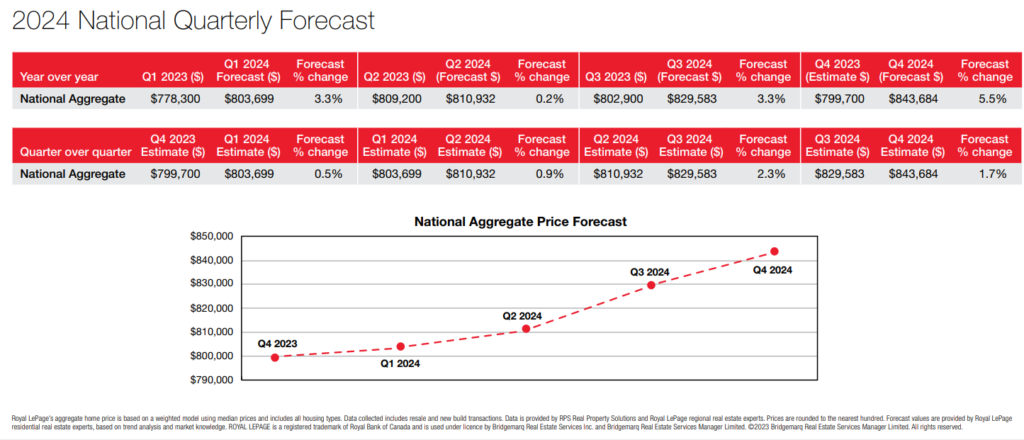
https://marketing.rlpnetwork.com/Communications/2024_Royal_LePage_National_Quarterly_Forecast_Chart.pdf

Greater Toronto Area

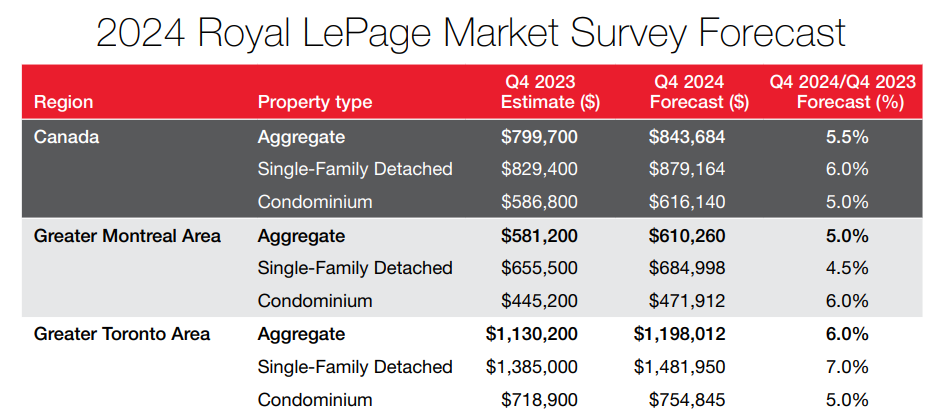
In the Greater Toronto Area, the aggregate price of a home in the fourth quarter of 2024 is forecast to increase 6.0 per cent year over year to $1,198,012. During the same period, the median price of a single-family detached property is expected to rise 7.0 per cent to $1,481,950, while the median price of a condominium is forecast to increase 5.0 per cent to $754,845.

“There is a lot of uncertainty surrounding Canada’s economy and the real estate market these days, and that is especially true in the major centres like Toronto. What is certain is that Canadians need housing, they value home ownership and most are willing to prioritize buying a home over just about anything else,” said Karen Yolevski, chief operating officer, Royal LePage Real Estate Services Ltd. “We know there are still buyers on the sidelines waiting for interest rates to come down. What is unclear is how many can afford to jump back into the market at the first sign of a reduction, and how many truly cannot afford to transact in this environment.”

Yolevski added that a lot of future activity will be dependent not only on reduced interest rates, but the timing of mortgage renewals. Many would-be move-up buyers who have enjoyed ultra-low rates for the past few years will be willing to make a move as their current loan terms expire. No longer bound to their current property because of the interest rate, more of these owners will put their properties on the market and begin their search for a new home.

“The GTA is Canada’s most densely-populated region and continues to be the top destination for newcomers. Despite a temporary drop in sales, there remains a huge gap in the number of homes available and those needed to satisfy demand from middle-income earners. This continues to put significant pressure on the already-tight rental market.”

Yolevski also noted that investor-owned properties, namely condominiums, could add supply to the market over the next year or two, as mortgages come up for renewal and owners choose to sell rather than renew at a higher rate.

“If tenanted properties are not producing positive cash-flow, investors may choose to sell rather than renew their mortgages in this higher-cost borrowing environment. This, in addition to new legislation that incentivizes the development of purpose-built rental properties, could add some much-needed inventory to the entry-level market,” said Yolevski. “It will not be enough, however, to put downward pressure on prices.”

This content piece is a redacted version of the Royal LePage Market Survey Forecast and is meant for information purposes only. The full article can be found at https://reganteam.ca/blog/

https://www.royallepage.ca/en/realestate/news/the-great-adjustment-canadians-to-adapt-to-new-reality-as-housing-market-returns-to-near-normal-in-2024/?fbclid=IwAR2ANWgaPWg86DEd7YLhVA7iJrFbW2qOOHvcXwUTHZIJy6VV1ZLofsaABqc

Recent trends in Canadian housing market

The Canadian housing market has been witnessing significant changes in recent years, characterized by soaring prices and affordability challenges.

Come on a journey with us, to uncover the increase in Canada home prices and how it’s affecting first-time buyers, especially in bustling cities like Toronto, Vancouver, and Montreal.

Join the adventure of exploring various regions, unraveling the mysteries of government rules, and diving into the exciting forecasts that paint a vivid picture of what lies ahead for future Canadian homeowners.

Let’s embark on this friendly exploration together!

Rising prices for the to-be home owners

Home affordability in Canada has seen a significant decline since 2020.

Families are dedicating a larger portion of their income to the housing expense due to the rise in mortgage. In just two years, there was a significant rise in mortgage from 46% to 69%, making the home ownership more challenging.

In November 2023, Canada housing market had a gentle shift in national home sales, as shared by the Canadian Real Estate Association.

The numbers showed a tiny 0.9% decrease in home sales from the previous month. Compared to November 2022, the activity for that month was 0.9% less, suggesting a steady, though slightly quieter, market.

Regional Differences in Canadian Housing Prices

Discovering homes across Canada reveals a delightful diversity in prices. Big cities like Toronto and Vancouver often show a surge in prices, while other places see more gentle, steady growth. The reason being, changes in job opportunities, more number of immigrants and the overall economic health in each community.

Friendly Government Rules and Their Impact on Homes

The Canadian government rules are turning friendly for the to-be home owners. These rules are like guides shaping the housing market. They put in place clever ideas, such as taxes and tests, to make sure everything stays fair and balanced. These rules not only keep things in check but also help slow down price growth in certain areas.

Looking into the Crystal Ball

In November 2023, the average Canada home price across the country stood at $646,134. During the same month, there were 35,013 home sales nationwide, reflecting a 16% year-over-year increase.

In Ontario, the Canada housing market grew by 1% compared to last year, with the average home price at $833,525. Yet, like the national trend, there was a 3% decrease in the Ontario housing market from the previous month.

Let’s peek into the future of Canadian homes!

It is evident that the average re-sale house price might take a little dip to about 789,000 Canadian dollars by 2024. This is like a friendly wave, marking the first-time prices might go down since 2019. In addition, according to a recent study, British Columbia might see a gentle decrease in housing price from 1.1 million to one million by 2024.

The Challenges of Home Hunting awaits Brighter Days

The Canadian housing journey has its share of challenges. The housing prices are high, and finding a home that fits the budgets can be a tougher task.

But here’s the good news. There are signs that changes, like new rules from the government and possible drops in housing prices, might be just around the corner.

These modifications could make it easier for all the families who dream of being the home owners, to find homes that not only feel like one but also fit snugly into the budgets.

DO ALL REAL ESTATE AGENTS CHARGE THE SAME FEE?

Asking whether all real estate agents charge the same fee is like asking if Rolex and Timex are made the same way. Every Realtor is different and offers a wide variety of differing services and skill sets. Therefore real estate fees and commissions vary to a large degree.

In the province of Ontario, it is against the law for a Realtor to price fix. This gives the home seller the ability to discuss and negotiate the fee.

Real estate commissions are all over the map and so are the services the real estate agent can offer. Homeowners are encouraged to clarify what services are included in the real estate commission.

All home sellers should budget accordingly for their home sale. Real estate expenses such as lawyer fees and moving costs should also be considered. Your real estate broker should be able to share estimations with you.

If you think your home is tax deductible or has tax deductions, it’s best to speak to an accountant beforehand.

Hidden Traps of Realtor Advertising

Some real estate teams claim to have big advertising budgets and to do a lot of marketing. And many of them do. However, does their form of advertising benefit you, the home seller?

Often, the marketing budget is spent on advertising the Realtor so that they can get new business and sell other houses.

When selecting a Realtor make sure to study their real estate advertising and marketing habits. Does an advertisement claim their number one in a given the old or are they spending the marketing dollars on text that relates to drawing a buyer to your home?

Real estate agents make money off of developing leads. In turn, they take the lead and sell a home to another buyer. It’s important that your home is being marketed and targeted to the appropriate audience that is going to bring you the best price for your home.

Beware of agents that charge a flat fee for service. That could allude to the fact that they are not investing in the process. On the other hand, agents who charge a high fee but only advertise themselves with the hopes of getting a real estate lead, do not necessarily help you.

Agents that charge a low fee and insist on doing open houses may have a hidden agenda. You don’t want your house to become a store for that agent to pick up buyers that are not qualified to buy your home.

Why Do Real Estate Costs Differ Amongst Brokers?

Similar to the Rolex/Timex comparison, there are a lot of differentiators amongst real estate professionals. Like the old saying goes, you often get what you pay for.

Simply put, if you hire a full-time, full-service broker, you can expect many extra services that a low fee-for-service agent just cannot offer.

Like everyone in business, Realtors have expenses, such as home staging services to professional home improvement costs. Real estate marketing and advertising make up a large part of expenses.

As a home seller, if your goal is to maximize the price of a sale in the least amount of time, one needs to expose the home to the greatest number of qualified buyers. How do you do that? You need an agent who invests in the process.

Banks charge interest rates on mortgages so they can make a profit. Realtors charge a commission to cover their expenses and to make a profit. A profit for their ability to negotiate and for their tenure in the industry brings experience to the homeowner.

How Much Does It Cost to Sell a Home?

This answer usually lies in the quality of service a real estate agent is offering to the home seller. There are many moving parts and expenses to getting a home sold that a real estate brokerage takes on.

Generally speaking, a Realtor with a big advertising budget can increase the chances of getting a home in front of more qualified buyers.

What Costs Should a Home Seller Expect Beyond a Commission

Every home is different and therefore will have varying expenses including home staging and painting before going to the MLS or Realtor.ca. Some home sellers should consider having their home inspected prior to listing. This avoids any surprises later and can be done by a home inspector.

Property taxes should be brought up to date to avoid headaches on closing. Capital costs such as home renovations should be thoroughly talked through with a local Realtor and stacked up against other homes for sale in the area.

Repairs and maintenance are just parts of owning a home and a good seller’s agent will be able to distinguish between what should be improved and what is not necessary.

Sometimes in the commission rate the Realtor will play a hand in organizing and paying for minor repairs. If you’re going to sell your house, it’s often with the minor repairs.

Keep in mind real estate expenses such as lawyer fees and moving expenses. If you’re moving down the street versus across the country, costs can vary dramatically.

Most lawyers include in their fee ledger land transfer tax and title insurance. Make sure to get a breakdown from your lawyer ahead of time. Some sellers will need it for tax returns or income tax purposes.

If you have been receiving rental income from your home, you might consider speaking to your accountant. Also, if you buy and sell frequently, CRA may deem the net proceeds from your sale as income.

Advice in a Nutshell

  • Not all Realtors are the same and neither are their fees
  • Real estate fees and commissions are negotiable
  • You generally get what you pay for
  • It takes money to make money so if selling for a high price is important, make sure to choose an agent with a large marketing budget

Real Estate Brokerage Fees Explained

If you are selling your home, you should know how real estate brokerage fees work. In the province of Ontario, there are no hard and fast real estate fee rules.

With one exception. Price fixing is not allowed which means there is no manual explaining how real estate fees work. Here it is in simple terms.

How Are Real Estate Fees Determined?

Real estate fees are most often a percentage of the sale price of a home. Which is kind of cool because the more money a Realtor can sell your home for, the better for everyone involved. In other words, the percentage model incentivizes a real estate agent to get higher prices for the seller.

Are There Other Ways Realtors Charge?

In other models, there is a flat fee for service. Though not as prevalent, flat fee models usually are just that. Sometimes based on the real estate brokerage business model, a single price or tiered pricing based on what the seller wants from the brokerage they have selected to help them sell a house. In Ontario, this is less common than in other western provinces.

How Does My Realtor Get Paid?

What’s important to know is there are usually two sides to the transaction. The listing brokerage side (represents the home seller) and cooperating broker aka the buyer’s broker (represents the home buyer). Both parties get paid and it’s usually handled on the listing brokerage side.

When the seller signs a listing agreement with a brokerage to sell their home, the listing brokerage discusses with the seller how much their fee is and a discussion of how much to offer the buyer’s broker as an incentive to bring buyers. These are not fixed costs so you are best to discuss this with your listing brokerage as soon as you meet with them to discuss the selling process.

How Do I Determine What Commission To Offer The Buyer’s Agent?

I had a client once who described through her lens how she viewed the buyer’s brokerage incentive fee. She said it was like buying insurance.

Though agents are not allowed to discriminate against a lower fee and not show a particular home, agents are human. And Humans are driven by incentives. Consult with your local agent beforehand and ask what the going rate being offered is in your marketplace.

Do All Realtors Charge The Same Fee?

Real estate fees are all over the map. There are no two real estate brokers that are the same and all of them provide different services such as how they market and advertise your home. Home staging, decluttering services, home improvement contacts are but a few of the services a full service broker can offer. Needless to say, these services cost money.

How Do I Choose The Best Broker For My Needs?

A seller is advised to choose a broker that best meets their needs. Oftentimes a real estate agent has trusted contacts that have worked with other clients in the past. This can bring assurances and trust to the decision of whether to apply these services to your needs.

If selling your home for the most amount of money is important, then remember, you often get what you pay for. A low service fee agent will provide just that, oftentimes low service. On the other hand, A real estate brokerage that charges a high fee better be able to back up why they do so. Often these answers and a clear decision is made when interviewing and understanding what the Realtor provides.

How Long Does It Take To Sell My House?

There are many factors that determine how long a house might take to sell. A low-fee agent may put your home on the MLS (multiple listing services) website and wait. Also referred to as a passive agent.

Sticking to the theme of you get what you pay for, a higher service fee agent will expose your home on more websites to more potential buyers. Generally speaking, the more people that know your home is for sale, the more likely you are to sell it quicker and for more money.

Advice In A Nutshell

  • Do your homework
  • Meet with an agent that you feel can best deliver on your needs
  • Be wary of discount brokers
  • You get what you pay for
  • What may feel like savings on fees could cost you more in the long run if the sale price is not maximized

Do I Get A Better Deal If I Buy A Home Through the Listing Agent?

There is an often misinterpreted myth in the real estate world amongst would-be home buyers that if they offer on a house for sale to purchase, they will get the home at a lower home sale price if they use the listing real estate broker.

Understanding The Listing Agreement Between the Home Seller and Listing Brokerage

The listing agent (Listing Brokerage) has a Listing Agreement with the seller of the home. Which means they have a fiduciary duty to the seller to act in their best interest throughout the home selling process – including the negotiation of best terms and price in favour of the seller.

Some fiduciary duties are: 

  • undivided loyalty to the client
  • acting in the best interests of the client at all times
  • the duty to avoid all conflicts of interest the duty to disclose all conflicts of interests when present

A buyer has the right to pick any licensed real estate agent of their choosing. It does not have to be the listing broker who represents them when submitting an offer to purchase. 

Some listing brokerages will charge a low commission or give a better commission rate if they can bring their own buyer. As a home seller just be careful that does not interfere with your best interests. 

What Fiduciary Duty Is There To A Buyer

When a home buyer engages a Realtor to purchase a home, they must sign a number of provincially regulated forms.

These forms spell out the fact that if the home buyer uses the home seller’s agent to purchase the home, the Realtor representing the seller as an obligation to the home seller to protect their best interest.

This type of situation is what’s known as dual agency or multiple representation. This can create a conflict of interest if the rules are not followed during the real estate transactions.

In most dual agency situations, the duty is to the seller and not to the buyer.

Are You A Home Buyer That Prefers To Deal With The Listing Agent?

If you’re a home buyer that just prefers dealing with the listing agent, not necessarily looking to get a better deal, you should know what your rights are.

Under the Real Estate Council of Ontario’s code of ethics, there are certain things that a realtor should explain to you. One of the forms you will sign is called working with a realtor as well as a buyer representation agreement. These forms are in place to protect a buyer’s rights.

There are two types of representation that a buyer could seek. Although the terms “client” and “customer” are typically used synonymously in some businesses, they mean different things in real estate transactions and can have separate implications for a potential buyer and seller.

Make sure when you engage the listing agent that that listing agent has made clear to you what type of representation they will offer to you.

When Does A Conflict Of Interest Arise

Most conflicts of interest arise when a homebuyer interacts with the listing agent who already is under contract with a home seller. The conflict of interest usually lies around negotiating a better price for the buyer.

In a real estate deal, there is a purchaser and there is a seller. They have opposing interests. 

As a home buyer it’s important to know what your rights are so ask a lot of questions to the agent before submitting an agreement of purchase and sale to a home seller.

An ethical agent will follow the Real Estate Council of Ontario rules and regulations. They will walk you through the necessary paperwork and explain to you what the different types of representation you are entitled to. 

An ethical agent will also explain to you what the listing agreement actually means as it pertains to their obligation to the seller.

Included in the listing agreement is the real estate fees and how the Realtor and Listing Brokerage get paid. 

Advice In A Nutshell

  • Nowhere in any of the documents to be signed does it say the buyer stands a chance of getting a better deal.
  • In fact, it is the opposite as the listing agent’s fiduciary duty is to the seller
  • A home buyer should understand what the difference between customer service is and client
  • A realtor is held to a strict code of ethics governed by The Real Estate Council of Ontario and other provincial jurisdictions. 
  • If the listing real estate agent is found to be in a conflict of interest, an ethical agent will always default to their fiduciary duty to the seller 

The Weigh Scale Approach to Decision Making

Would you like to capitalize on this incredible real estate market but aren’t sure if it’s the right time? Well, get in line. There are a lot of homeowners right now that tend to feel trapped. Not in the literal sense, of course, but from the simple standpoint of, ”It’s not the right time.”

Recently, we helped a family make a difficult decision on whether to sell now or wait a few years until their kids had graduated high school. Another family we helped wasn’t sure whether to wait two more years until their retirement. And yet another family we helped were recent empty nesters and weren’t sure whether to keep the house for when the grandkids came to visit. These are just a few classic examples of decisions families had to make when balancing the value of the emotional and economic situations. Is now the time to capitalize on the equity that you’ve built in your home through a hot real estate market?

The families mentioned were able to make an educated decision via the Scale Approach. Picture a weight scale. On one side of the scale is where you place the emotional factors. On the other side you place the economic factors. After you’re done weighing the factors, the side that weighs the most may be your answer.

We’re here to help! The Regan Team specializes in helping families make tough decisions. It’s never too early to start planning. The first step is making the phone call to set up a 45-minute meeting. In that meeting, we need to address a few things, regardless of whether or not you’re selling tomorrow or in five years.

  1. What is the value of my home today? Like an annual check-up with the doctor, it’s good
    to have a yearly check up on your largest asset. You may be pleasantly surprised.
  2. What low cost improvements can I make to increase the value of my home before I put
    it up for sale? For example, a dollar spent on a coat of paint can increase your margin by
    five times when selling.
  3. Last, but not least, let’s talk about a game plan. A good game plan is the foundation to
    good decision making. And we have tons of experience in tried and tested game plans.

Here are a few ideas that we’ve heard from others in your position.

Emotion:

  • My kids are still in school
  • My grandkids want to visit
  • The dog needs a backyard to run in
  • I’ve been in my home for years
  • Close to familiar amenities
  • Proximity to work

Economic:

  • My house is worth more money than ever
  • I like the idea of selling for maximum profit and putting some cash in my pocket
  • I can now afford to accomplish my goals and live my dreams
  • I’ve built incredible wealth through owning my home
  • Maybe now I can afford to help family and friends
  • Simplifying my life sounds good

What No Real Estate Agent Wants to Be Asked in an Interview

The 1 Question Every Home Seller Should Ask Their Real Estate Agent:

You have made a decision to sell your house. You’ve been in your home for years and the thought of selling your home is daunting. There are so many things to consider and the anxiety is piling up high.

Don’t worry, there are hundreds of real estate brokerages out there that can help you. Ontario alone has over 70,000 licensed real estate agents.

However, with so many options to choose from, selecting the best Realtor to represent you can be daunting.

Doing your due-diligence at the beginning of the process is very important in selecting the right real estate brokerage to represent you.

It’s important that the Realtor is not too busy to handle your needs. Afterall, you want a successful home sale. Understanding how the agent operates and what other obligations beside your sale they have on their plate can help you make the right decision.

There may be other homes for sale in your neighbourhood that you are competing against. You may need to get your home inspected prior to sale. Finding red flags before you sell your house is important. Real estate agents can help with this—if they have time.

How Do You Know How to Select the Right Real Estate Agent?

Selecting the right real estate broker can be a daunting task. Understanding their business model is key. In order to do so, as the homeowner, you must ask questions and do your homework.

Reading a Realtors Facebook and Google reviews is important. Watch out for fake reviews and concentrate some of your time on the negative reviews. Look for key words, like selling price and the person’s experience.

Is the real estate agent an independent or solo agent? Are they the team leader responsible for a big team? Is it a husband and wife duo?

All of these come with pros and cons. It’s important, as a home seller, to do your homework and understand what is best for you.

Asking the Big Question

If you only ask one question, ask the real estate agent you’re interviewing what their business model is. This will give you an insight and a look into the future to see how your sale may go.

An independent real estate agent wears many hats. Though they try to promise one-to-one service, and many do a good job at it, they may lack other resources, such as a marketing team, digital ad management and social media expertise.

A team leader wears many hats. Hiring and firing. Payroll and accounting. Marketing and advertising.

More often than not, a team leader will struggle to devote the appropriate amount of time and attention to detail required to complete a successful sale.

A balanced business model is probably best. Such an agent will have the time to dedicate to your home sale by finding a home buyer, speaking with agents and securing the best price for your home.

They can do this because they have an organized marketing team behind the “A Team” of specialists that answers the phones, manages employees and looks after other important day-to-day tasks.

After You Ask the Question, How Will You Know You Got an Honest Answer?

You will know you got the right answer by following a few steps:

  1. Look on the agent’s website.
    1. How many listings are they carrying at any given time?
    2. How many agents and support staff are listed?
  2. What is the role and responsibility of the agent you are interviewing?
    1. Are they busy managing admin and support staff?
    2. Do they have a large number of agents they are responsible for managing?
  3. Can they clearly define their business model?
    1. Ask them to define it.
    2. A red flag should go up if you’re not convinced you’re going to get the attention you deserve.

Picking an Agent

There are other filters available to you that could help you make a decision when it comes to picking a Realtor. When selecting a Realtor, ask:

  • What interest rate environment are we in right now?
  • Are monthly mortgage payments a factor for buyers when they look at my home?
  • What price range can I expect my house to sell in?
  • Are flat-fee services better than percentage-based service fees?
  • Are first time homebuyers a factor in my market place?
  • What services do I receive for the commission rates charged?
  • What is included in your real estate fee?
  • Is this person amongst the top real estate agents in my local market?
  • Can you explain the land transfer tax?
  • Does a buyer have any tax credits they can use when selecting my house?

By asking some of these questions, selecting an agent will be easier, as you’ll gain insight as to whether this Realtor knows their stuff.

Advice in a Nutshell

  • Do your homework before interviewing an agent
  • Be wary of agents with big team rosters
  • If they carry a lot of listings, will they have time to devote to your needs?
  • If they cannot communicate their business model in a way that benefits the home seller, be careful

Here We Go…Again

I’m going to make a bold statement…The real estate market has caught fire again!

For the past 8 to 12 months the real estate market has been in a dormant state. Like someone turning off a light switch the moment the Bank of Canada (BoC) started to raise interest rates, the real estate market has been dormant. Buyers that were competing against dozens of other offers in 2021 and the first quarter of 2022 to buy a house, all of a sudden were on the sidelines.

The cost of borrowing money in the form of a mortgage felt like it doubled overnight. Why would anyone buy a house with no end in sight on rising interest rates? Well, again, like a light switch, the moment the BoC said they would halt rate hikes for the remainder of 2023, there was a spike in the demand for real estate.

“There has been nothing ‘typical’ about Canada’s housing market since the start of the COVID-19 pandemic. Lockdowns brought the housing market to a grinding halt in early 2020 before the work-from-home revolution catapulted it into a two-year, all-season frenzy of record sales volumes and aggressive price growth,” said Phil Soper, president and CEO of Royal LePage. “As markets do, this market overshot, and the inevitable correction was triggered when the Bank of Canada began to rapidly raise interest rates. The downturn came swiftly, and the real estate industry remained depressed for 12 months. We have turned the corner and the housing economy is growing again; none too soon for many buyers, who have been waiting patiently for prices to bottom out.”

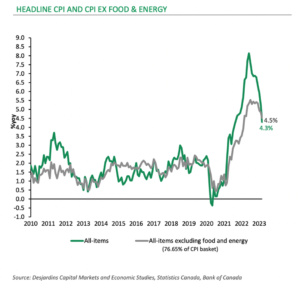
More good news is on the horizon, as this is the first time we have seen inflation reports that begin with a “4,” since 2021. And with lower inflation comes lower interest rates. Think of interest rates as either the gas pedal to price appreciation or the brake pedal, which lowers demand and thus reduces value.

Unless we see something drastic happen in Canada’s economy like a surge in crude oil prices or another surprise event, the Bank of Canada is predicting 3% inflation by this summer. Though still considered high when compared to an inflation target in the 2-2.5% range, this is good news when coming off a high of 8%.

A recent Royal LePage survey found that nearly one quarter of Canadians (24%) were in the market for a new home over the last year, and 63% of them said they postponed their plans due to rising interest rates. Of those who put their plans on hold, 26% said they plan to resume their search this spring, and another 36% said they would return to the market in the near future, once the Bank of Canada holds rates for several consecutive months.

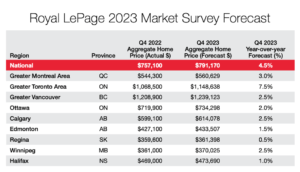
Royal LePage is forecasting that the aggregate price of a home in Canada will increase 4.5% in the fourth quarter of 2023, compared to the same quarter last year. The aggregate price of a home in the Greater Toronto Area decreased 11.8% year-over-year to $1,119,900 in the first quarter of 2023. On a quarterly basis, however, the aggregate price of a home in the GTA increased 4.8%.

While sales are way down in the Greater Toronto Area compared to the record highs reported in the first quarter of 2022, on a month-to-month basis, sales were up 54% between January and February, and 44% between February and March; and new listings were up 9% from January to February, and 34% February to March.

Royal LePage is forecasting that the aggregate price of a home in the Greater Toronto Area will increase 7.5% in the fourth quarter of 2023, compared to the same quarter last year. The previous forecast has been revised to reflect current market conditions.

If you have found this information to be as clear as mud, please reach out. We’re here to help. And please remember, the real estate market is big. The neighbourhood and street you live on is small. There are many factors that go into the price of a home and we can help with that.

Source: Royal LePage and Connolly Capital Mortgage Solutions