Toronto Real Estate Market Picks up after Lull

CAROLYN IRELAND

The Globe and Mail

Published Thursday, Aug. 03, 2017 8:00AM EDT

Last updated Thursday, Aug. 03, 2017 8:00AM EDT

Home buyers in Toronto and some of the surrounding areas appear to be testing their mettle again after spending a few weeks on the sidelines.

It’s too soon to tell if a flurry of sales signals a trend with staying power or if some buyers simply need to move on with their lives, but the action – especially at the high end – suggests some resilience in an uncertain real estate market.

Janet Lindsay, a real estate agent with Chestnut Park Real Estate Ltd., recently listed for sale 253 Russell Hill Rd., a six-bedroom house in the posh central enclave of South Hill. Within three days the first offer landed, Ms. Lindsay says. Two days after that, the second and prevailing offer arrived and the house sold for $100,000 above the asking price of $3.65-million.

“More appointments were being booked as we waited for the certified cheque,” Ms. Lindsay said. About 30 potential buyers attended showings during the few days the house was on the market.

July and August typically offer a bit of a lull between the more vigorous spring and fall markets, says Matthew Regan, a real estate agent with Royal LePage Real Estate Services, but he has noticed a recent bounce in Mississauga and Oakville, where he does most of his business.

“In the past couple of weeks, I’m seeing life.”

Mr. Regan has been keeping an eye on a house listed in the coveted Lorne Park area of Mississauga in the fall of 2016 with an asking price of $3.5-million. The property rode the fall market into an even better spring market and into the summer without selling, Mr. Regan says. Last week, the property sold – without the owners ever cutting their asking price, he says.

Mr. Regan says sellers have mainly been falling into two camps – those who have a reason to sell and those who are just testing the market. The former have tended to sit and wait while the latter have been pulling their houses off the market if they don’t get the amount they’re looking for.

“The other kind of seller was the kind who just went fishing – cast a line and said, ‘I’ll see if I get my fish.’ They got tired.”

Mr. Regan cites another example, where a house was listed in the late spring in the popular River Oaks neighbourhood of Oakville with an agent in Mr. Regan’s office. The asking price of $1.198-million tends to draw buyers to the coveted school district.

“That’s a sweet spot because $1.2-million is affordable for a lot of buyers in Oakville,” Mr. Regan says.

In the middle of June, about 32 properties were listed for sale in the pocket.

“Nothing was moving.”

Recently, the house sold for $1.1-million. The sellers were happy, Mr. Regan says, because they still received more than they would have if they had listed last summer. When Mr. Regan looked at the house in the fall, he estimated it might sell for $950,000 or $975,000.

The homeowners may have received more in the early spring, he says, but it’s very difficult to time the market perfectly.

“In February or March, they might have sold it for more money, but that would have been luck – pure luck.”

In April, the Ontario government announced new measures aimed at cooling an overheated market in the Greater Toronto Area and beyond. Jittery buyers became fearful about buying in an uncertain market while listings surged as some sellers rushed to cash out.

In May, the market stalled as players on both sides tried to figure out the impact the rule changes would have.

Mr. Regan says listings in River Oaks are still sitting, but one sale may lead to others because the pocket now has a new benchmark price. Also, prospective buyers can see that other house hunters are stepping forward.

“They’ve elected to buy a house where no one was buying a house for a month or two months,” he says.

Mr. Regan says the sellers who were just fishing for a high price were diluting the market. As they drop out and buyers return, he hopes to see a healthy market balance.

“What isn’t a healthy market is a pool of sellers just sitting and buyers scratching their heads.”

He expects inventory to rise in the fall as usual at that time of year, but he doesn’t predict a surge.

“The people who got tired of trying for an unrealistic number, it’s unlikely they’ll go back in the fall,” he says.

He also doesn’t expect a repeat of the zaniness of the spring, with prices climbing at warp speed. Buyers became fed up with bidding wars, he says, and few agents are still setting artificially low asking prices in the hopes of sparking one.

“That strategy is gone.”

He predicts that most agents will list houses with an asking price close to the market value and accept offers any time.

For buyers, he expects that “old school” way of negotiating a purchase to come as a relief.

“You don’t have to panic,” he tells buyers, “like in the spring, when a half-decent house would have been gone in 48 hours.”

Elli Davis of Royal LePage Real Estate Services Ltd. says she has fewer listings than normal at the moment and she is encouraging potential sellers to list after this weekend’s holiday.

“After the long weekend in August, I almost find like that’s the turn,” she says. “The buyers are there anyway.”

She recommends that homeowners set a reasonable asking price for their location and style of house. In midtown Toronto, she rarely holds back offers now, but on occasion a house merits that approach.

“Sellers have to be realistic. It’s a one-by-one conversation. No two listings are the same.”

Ms. Davis recently sold a small, one-bedroom condo unit in the Distillery District. The condo, in the $350,000 range, sold for $25,000 above asking.

She listed the unit on a Thursday without an offer date, but when she saw the demand, she set a deadline for the following Monday. The sellers received four offers.

“It was the right move because they certainly got more on the Monday than they would have on the Friday.”

She says the condo needs updating, but a lot of people are looking for an older unit to renovate.

After the long weekend, she plans to list a three-bedroom condo unit at 110 Bloor St. W. with an asking price just under $2-million. The 2,600-square-foot unit is in original condition, which is rare in a 35-year-old building.

“People like that. If it’s going to be renovated, just do it all at once and make it to their own taste.”

Ms. Davis does know of some houses that have been sitting on the market, but she believes some sellers are too optimistic. If they refuse to budge from their asking price or plan to retreat and list again in the fall, she predicts they will have less success. She would do the opposite – stay on the market and trim the price, she says.

“I wouldn’t wait until after Labour Day. I’m putting properties on now because there’s not much.”
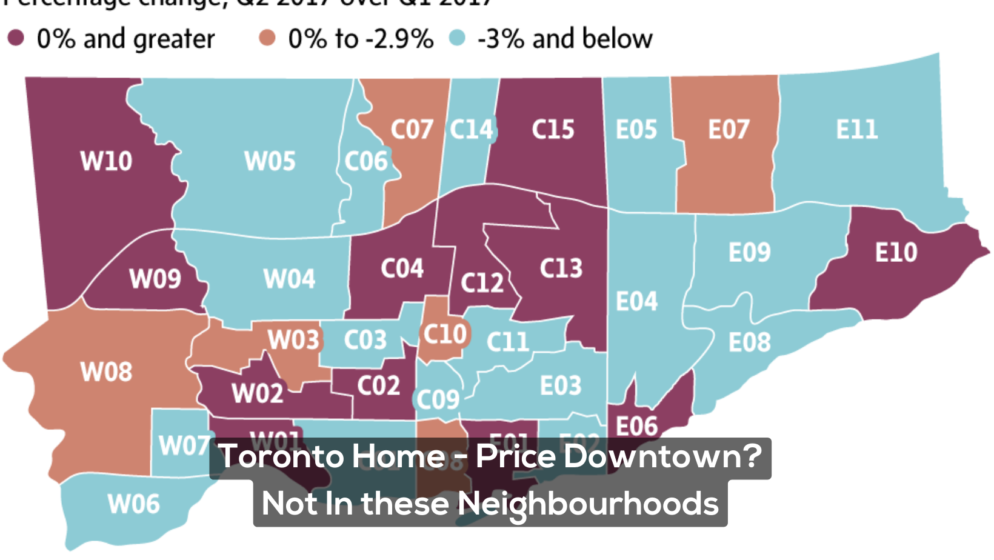
Toronto Home-Price Downtown? Not in these Neighbourhoods

JANET MCFARLAND

REAL ESTATE REPORTER

1 HOUR AGOJULY 27, 2017

Toronto’s housing downturn is not being felt equally across the region, with many neighbourhoods still seeing the prices of detached houses climb even while the average price falls across the Greater Toronto Area.

A new report by realty firm Re/Max Integra shows that 40 per cent of 65 districts within the Toronto Real Estate Board recorded detached house price increases in the quarter ended June 30 compared with the first quarter of 2017, including almost half of all the districts in the 905 region surrounding the city of Toronto.

The data suggest the GTA is facing an uneven downturn in house prices that is not being felt to the same extent in some hot neighbourhoods or in certain areas with generally lower prices that remain attractive to first-time buyers.

The numbers also support predictions that Toronto’s recent downturn in house prices may reverse course later this year.

Canada Mortgage and Housing Corp. is already anticipating a shift in the Toronto housing market, according to Dana Senagama, a principal market analyst for Toronto. She said the sales downturn in response to new housing measures announced by the Ontario government in late April already seems overblown in light of the region’s economic fundamentals.

“The response we were seeing in the Toronto market seems almost emotional and almost a knee-jerk reaction to some of the changes, which suggests that these impacts will be short-lived if all other fundamentals remain intact,” Ms. Senagama told reporters Wednesday as CMHC released its quarterly housing assessment for Canadian markets.

CMHC chief economist Bob Dugan told reporters that strong job creation and income growth in Toronto favour the housing market. He expects price growth to resume in the city.

House prices in the GTA rose 29 per cent in the first quarter of 2017 but slid in May and June after the Ontario government announced new policy measures, including a 15-per-cent foreign-buyers tax. The number of homes sold in June fell 37 per cent compared with the same month last year, while the average price for all types of homes across the GTA was down almost 14 per cent in June from the peak in April. Prices of detached houses dropped 12.4 per cent on average between the first and second quarters.

But many neighbourhoods and GTA communities have so far bucked the trend. For example, the township of Brock, northeast of Toronto, saw prices of detached houses climb 11.7 per cent in the second quarter, to an average of $562,711. Prices in Caledon rose 8.6 per cent, and Halton Hills saw prices climb 7.8 per cent, the Re/Max Integra report said.

In the city of Toronto, the Toronto Real Estate Board district known as C02, which stretches north of Bloor Street between Yonge and Dufferin streets and includes the Annex neighbourhood, saw detached house prices rise 28 per cent in the second quarter. Re/Max said the price increase was an anomaly as a result of more sales at the higher end of the market in the neighbourhood.

Prices in E01, which is east of the downtown and includes the Riverdale and Greenwood-Coxwell neighbourhoods, climbed 7.6 per cent in the second quarter, while prices in the western Toronto W02 neighbourhood, which runs north of Bloor from Dufferin Street to the Humber River, rose 6.9 per cent.

Christopher Alexander, Re/Max regional director for the Ontario-Atlantic region, said it is “quite remarkable” that prices in some neighbourhoods still climbed beyond the “record-smashing” increases in the first quarter.

Mr. Alexander said the vast majority of markets in the 905 region that recorded increases had average prices under $1-million, which suggests buyers were favouring less-expensive neighbourhoods. In Toronto, however, price increases varied more depending on the volume of new listings and the number of detached houses available for sale in the quarter.

“Some neighbourhoods had such a surge in listing inventory, especially after the government introduced the Fair Housing Plan, so there was a lot to choose from,” he said. “But other neighbourhoods didn’t really get the surge that people were looking for.”

Prices fell most sharply in the central downtown neighbourhood known as C09, which runs north of Bloor between Yonge and the Don Valley, dropping 21.6 per cent in the second quarter. Prices in the C01 district, in the heart of the downtown core north of Lake Ontario between Yonge and Dufferin, dropped 19.7 per cent in the second quarter.

Detached house prices dropped 7.75 per cent in Newmarket and 6 per cent in Vaughan in the second quarter.

Mr. Alexander predicted the next quarter, from July to September, will likely still remain soft because sales are typically weak over summer months, but he believes the GTA market will see more strength in the fourth quarter.

“I think people are going to be ready to buy again, especially if the government announces another [interest] rate hike. I think we’ll see a lot of people jump in,” he said.

DISTRICTAVG. PRICE (Q1 2017)AVG. PRICE (Q2 2017)% CHANGE
C01$2,039,795$1,637,293-19.73%
C02$2,121,994$2,715,14027.95%
C03$2,485,156$2,180,007-12.28%
C04$2,314,906$2,441,3005.46%
C06$1,695,020$1,518,812-10.40%
C07$1,991,873$1,959,490-1.63%
C08$1,812,000$1,778,785-1.83%
C09$4,249,438$3,331,250-21.61%
C10$1,963,808$1,913,103-2.58%
C11$2,162,543$2,042,770-5.54%
C12$4,183,675$4,237,1321.28%
C13$2,282,801$2,294,3900.51%
C14$2,663,544$2,579,737-3.15%
C15$2,097,757$2,104,1050.30%
E01$1,206,786$1,298,4397.59%
E02$1,505,341$1,375,293-8.64%
E03$1,122,166$1,048,539-6.56%
E04$869,115$839,646-3.39%
E05$1,277,114$1,147,935-10.11%
E06$974,520$1,009,1003.55%
E07$1,114,033$1,106,574-0.67%
E08$1,049,760$1,014,293-3.38%
E09$851,022$812,394-4.54%
E10$991,862$1,013,2072.15%
E11$820,017$780,578-4.81%
W01$1,635,022$1,725,4355.53%
W02$1,300,518$1,390,3426.91%
W03$811,812$794,200-2.17%
W04$1,012,305$935,246-7.61%
W05$971,269$894,478-7.91%
W06$1,036,428$950,680-8.27%
W07$1,362,504$1,311,176-3.77%
W08$1,538,276$1,501,611-2.38%
W09$1,026,757$1,050,6402.33%
W10$758,302$773,0281.94%

Source: RE/MAX

Province to sell Lakeview site as a part of Mississauga Waterfront Redevelopment

By TESS KALINOWSKIReal Estate Reporter

Tues., June 6, 2017

A 177-acre piece of Mississauga waterfront land owned by Ontario Power Generation (OPG) has officially hit the market.

The province announced on Tuesday that it is selling the old Lakeview generating station site east of Cawthra Rd., south of Lakeshore Rd. East.

The developer or consortium that buys the property will have to remediate the industrial lands before transforming the area into a mixed-use community expected to house up to 20,000 residents and 9,000 jobs.

“The province is relinquishing some value for the benefit of the community,” said Finance Minister Charles Sousa, MPP for Mississauga South.

The Lakeview site will become a new community of about 8,000 residential units, with generous green spaces, boardwalks, canals lined with restaurants and boutiques, wetland trails and a cultural event space.

“It will be connected to the rest of the waterfront in a way that will give residents a lot of comfort,” said Sousa.

He said a successful buyer should be identified by the fall. Commercial real estate company Jones Lang Lasalle is the agent for the deal.

Sixty-seven acres of the property have already been promised to the city and the buyer will be required to remediate that land as well.

Sousa said there is already plenty of interest, from developers but he wouldn’t speculate on how much the property is worth.

The nearby 72-acre Imperial Oil site to the west in Port Credit is expected to attract about $2 billion in residential and commercial development. It was bought by a consortium called West Village Partners, which includes the Kilmer Group, Dream Unlimited, Diamond Corp. and FRAM + Slokker.

Price will play a role in the successful bid for Lakeview, but the developer’s reputation will also be taken into account, said Sousa.

“We want to promote talent and experience in the local community, too,” he said.

Lakeview, which operated for 43 years before being decommissioned in 2005, “was a powerhouse in our economy,” said Sousa, who moved to the area when he was 7. But while he lived near the lake, Sousa said he never saw the water because the OPG station blocked the view.

But it was also responsible for some smog days, he said, remembering the white coal ash that would cover the cars in the neighbourhood.

Lakeview’s four smoke stacks known as the Four Sisters, were demolished in 2006.

https://www.thestar.com/business/2017/06/06/province-to-sell-lakeview-site-as-part-of-mississauga-waterfront-redevelopment.html

Matthew Regan’s Team Has It All

Barbara and I would like to thank you for all your support and help in listing and selling our house.

If we were asked by a friend about listing a house we would definitely suggest they list with Matthew Regan. While it may not seem that the listing agent, and his or her team matters, let us tell you…from our experience it does.

Some individuals may need to sell quickly, while others may want to do improvements to maximize their sale but aren’t sure what updating is most appropriate.  We would unconditionally say…trust Matthew!  It is important that your agent understands the value of your home and can present to potential buyers via various venues – such as YouTube; Internet; printed material as well as personal presentations. Matthew Regan’s team has it all.

Matthew, we found you knowledgeable and professional. Also, as we worked the plan together you gave us wise counsel along the way. With your input and suggestions we made a number of changes and, with your advice, tweaked the plan as we went along to hit our goal. Most importantly, we sold our home in a softening market when other homes for sale were stagnant.

Dealing with you and The Regan Team was a pleasure.  Although, selling a home can be stressful, your optimistic outlook and bearing, along with your principled approach, was reassuring.  It provided a balanced perspective for us with regard to market changes.

We conclude our message by saying thanks once again to you and your team, for a great job done!

– Nick & Barbara Sacco